Ace (1) of Cups
Appearance
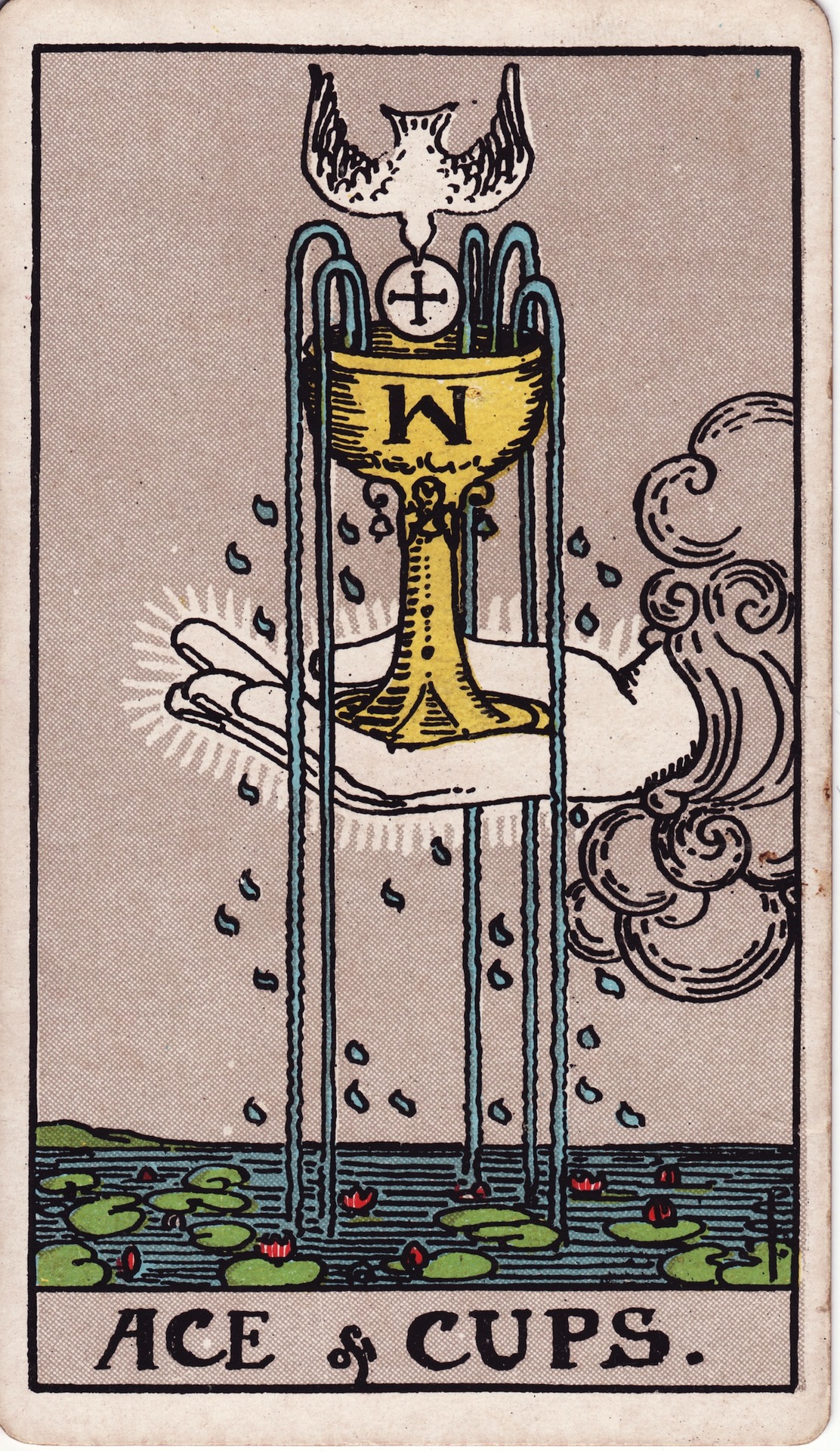
A hand emerges from a cloud on the right side of the card, palm open, holding a large golden cup. The cup is marked with a letter like an upturned W, or an M. Streams of water rise from it and pour over its rim on every side, falling into a still pool below where water lilies float, while loose drops scatter through the air. Above, a white dove plunges downward with a small round wafer marked with a cross in its beak, about to place it in the cup. A faint glow surrounds the hand.
Cups belong to water, the element of feeling, love, intuition and relationship, and the ace is the root of the suit, its whole force held in a single vessel. Waite saw in the card the Holy Grail and an intimation of "that which may lie behind the Lesser Arcana."1 Some readers take the cup as the inner, half-conscious self, and count five streams spilling from it, one for each of the senses through which feeling reaches us. The lilies, read as lotus flowers, become a sign of the spirit waking up, and the descending dove carries something from above down into ordinary awareness.2
Upright
The Ace of Cups is the beginning of feeling: love, joy, or emotional renewal arriving in a pure and concentrated form. Like all the aces it is a gift rather than an achievement, something offered from outside that asks only to be received. But an offer can be turned down, and the promise here comes true only if you meet it with an open heart and say yes.2 Waite's meanings center on the heart as a dwelling place: in his words, "house of the true heart," together with joy, contentment, nourishment, abundance and fertility.1
In love, it is one of the clearest signs of a new relationship or of a deepening in an existing one, the moment when affection becomes something you can name. The new bond need not be romantic; it may be a friend, or someone newly arrived in the family, and the giddy pleasure of finding them tends to spill over into how you feel about your own life.2 Given its link with fertility and the overflowing cup, it can also point to a pregnancy, a birth, or a happy event in the family; cards such as the Empress, the Page of Cups or the Four of Wands nearby make that reading more likely. Taken more loosely, the birth may be of an idea you are ready to pour yourself into.2
At work, the card favors projects you care about, creative work, and roles in the caring or healing professions; success here comes from being emotionally invested rather than merely competent. It is a good moment to start something artistic or take up a class, especially work that lets your feelings show, since you are at ease with yourself and willing to be seen.2 Money is not its main subject, but abundance in Waite's sense can include material comfort.1
Inwardly, the ace speaks of compassion, including compassion for yourself, and of intuition opening up. It also leans toward generosity: a time to give and to help, with the odd result that what you hand out seems to come back in more than one form.2 The cup is already full to overflowing; the invitation is simply to let it be.
Reversed
Reversed, the cup tips and the water goes elsewhere. The feeling may be present but blocked: held back for fear of being hurt, numbed after a disappointment, or bottled up until it leaks out sideways as irritability or tears. Sometimes the fear is of the feeling itself, that once it starts it will not stop. If you are not ready to show it, give it a private outlet instead, in writing, making something, or hard exercise, so it does not harden into a block.2 In love, it can describe affection that is not returned, a relationship that has lost its warmth, or an opening that one person is not ready to take. If you are the one holding back, it may be worth stepping away long enough to understand why before trust can grow.2 It can also point to delays around pregnancy and family plans, though it should not be read as a verdict.
Waite's reversed reading is "house of the false heart," with mutation, instability and revolution.1 This is the cup filled with something counterfeit: affection that is performed rather than felt, generosity with conditions attached, or an emotional life that changes direction with every mood. At work, it can mean going through the motions on a project that no longer means anything to you, or creative energy that has dried up.
A gentler reading is also common. Where the upright card sends love outward, the reversed one may turn it back toward you: tend your own cup before trying to fill anyone else's. It can likewise show feeling and intuition being explored quietly, on the inside, rather than shared just yet.2 The inner advice is to look at what you are refusing to feel. Sometimes the blocked cup is self-protection that has outlived its use; turning it upright again starts with being honest, first with yourself, about what you actually want.
Notes
- A. E. Waite, The Pictorial Key to the Tarot (1911), Ace of Cups, https://sacred-texts.com/tarot/pkt/index.htm
- Biddy Tarot, "Ace of Cups Tarot Card Meanings", https://www.biddytarot.com/tarot-card-meanings/minor-arcana/suit-of-cups/ace-of-cups/