Five (5) of Wands
Appearance
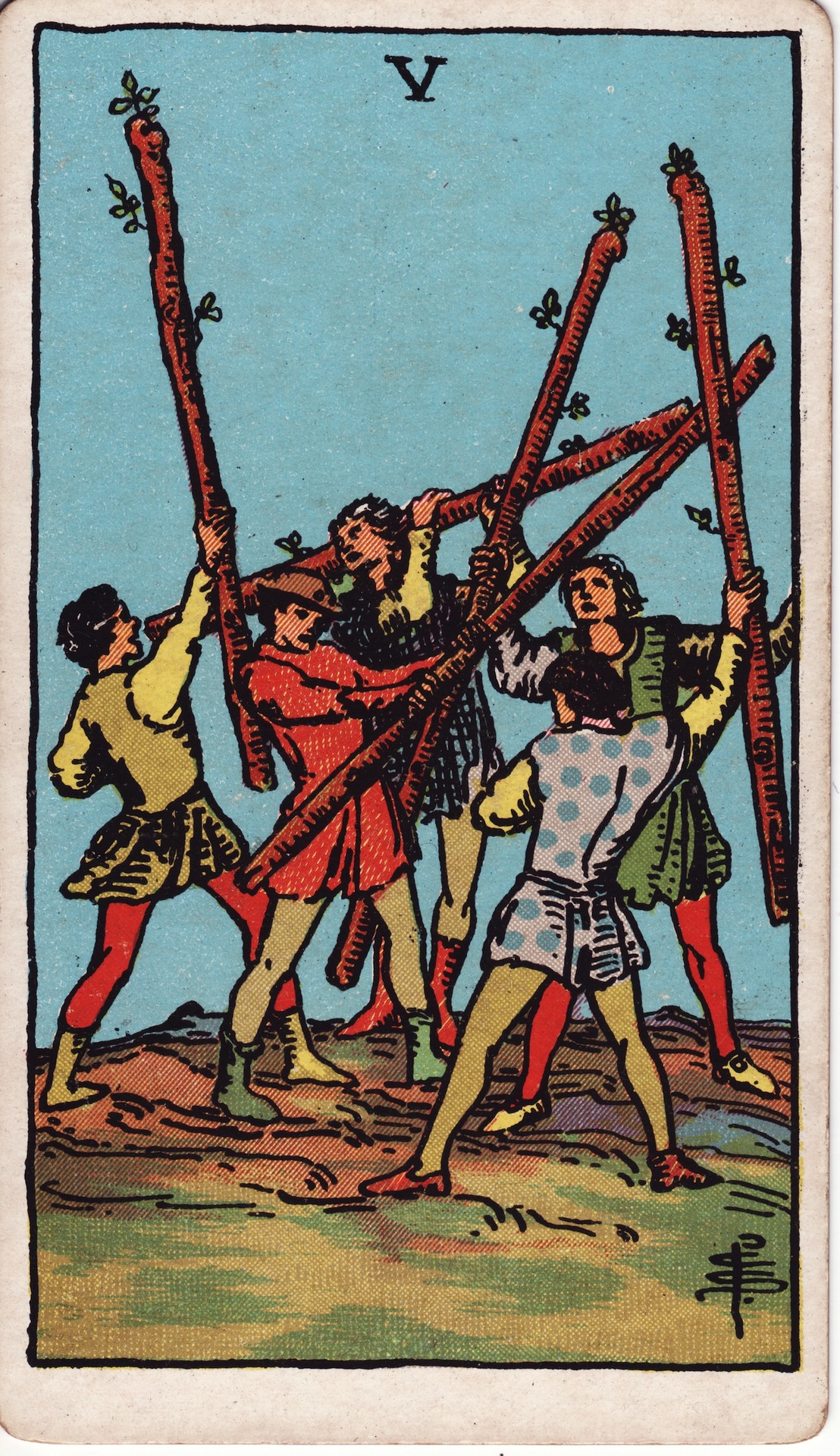
Five young men brandish long wands in an open field under a clear blue sky. Each is dressed differently, one in yellow, one in red with a hat, one in a dark netted tunic, one in green, and one in gray with blue spots, and their wands cross and clash above their heads in every direction. No one seems hurt and no blow is clearly landing; it is hard to tell whether this is a fight, a game, or a practice drill. The ground beneath them is rough and uneven.
Fives usually bring disruption after the stability of the four. Waite called the scene mimic warfare and read it as a sham fight, but also as the strenuous competition of the search after riches and fortune: in his words, the battle of life.1 The mismatched clothing can be read as five different upbringings and creeds, which is why the men cannot settle into a shared rhythm, and since the raised wands never seem to connect, the commotion looks less like a fight with a goal than like friction kept going for its own sake.2
Upright
The Five of Wands is the card of conflict, competition, and friction among many voices. Everyone has a wand and an opinion, and no one is quite fighting the same fight. The struggle is usually more noisy than dangerous: disagreements, rivalries, and the clash of egos rather than open hostility. Still, it costs something, because every step toward your goal meets pushback and the group never pulls the same way.2
At work, it often describes a competitive environment: colleagues jostling for position, a brainstorm that turns into an argument, rival bids for the same contract, or a team without clear leadership. Often a change is underway and everyone is excited about it, but the excitement is scattered across a dozen ideas with no plan connecting them; the useful role here may be the one who names a single direction the whole group can carry out.2 It can also be healthy competition that sharpens everyone's skills, and the card sometimes suggests seeking that out on purpose: a working group or peer circle whose members come from different places and will poke holes in your plans until they get better.2 Waite noted that some older attributions make this a card of gold, gain, and opulence, the reward of the struggle for wealth, and his additional notes give it success in financial speculation.1
In love, it can point to frequent squabbles, competing priorities, or a relationship where both people are trying to be heard and neither is listening. For someone single, it may mean rivals for the same person or mixed signals from several directions.
The card can also describe friction with people whose culture or habits are unfamiliar to you, and it asks for curiosity about what they bring rather than resistance.2 On a personal level, it can describe inner conflict: several desires pulling against one another. The advice is to decide which fights matter and to listen more than you argue. Letting the other side finish often lowers the volume on their end, and people who feel heard are more willing to hear you in return.2 Then channel the energy into something that moves you forward.
Reversed
Reversed, the conflict either ends, goes underground, or turns inward. In the brighter reading, people find common ground, a dispute is settled, and the energy that went into arguing can now go into cooperation. At work, a team may finally agree on a direction, or a rivalry may cool into respect. There is relief in it: you no longer have to keep proving yourself, and old anger has been worked through enough that your relationships feel steadier.2
Turned inward, the card describes not knowing where you stand. You may be weighing whether to leave a job or a relationship while friends and family each push their own answer, and your view keeps shifting with every new argument or fact. That back and forth is useful work, but no choice will satisfy everyone, so the aim is the option your reasoning and your feelings can both accept.2
In the darker reading, conflict is avoided rather than resolved. Tension simmers beneath politeness, problems are left unspoken, and resentment builds. In relationships, this can look like dodging hard conversations to keep the peace, or one partner giving way every time. Some friction does real good by bringing the actual problem into view, so ask whether keeping things calm has meant quietly giving up on things you care about.2 It can also mean the opposite: a dispute escalating into something more serious.
Waite's reversed meanings lean that way: litigation, disputes, trickery, contradiction.1 Watch for legal trouble, unfair dealing, or arguments that shade into outright dishonesty. His additional notes offer a hopeful twist, that quarrels may be turned to advantage.1 The card asks whether you are avoiding a necessary conflict or prolonging an unnecessary one.
Notes
- A. E. Waite, The Pictorial Key to the Tarot (1911), Five of Wands, https://sacred-texts.com/tarot/pkt/index.htm
- Biddy Tarot, "Five of Wands Tarot Card Meanings", https://www.biddytarot.com/tarot-card-meanings/minor-arcana/suit-of-wands/five-of-wands/