Knight of Pentacles
Appearance
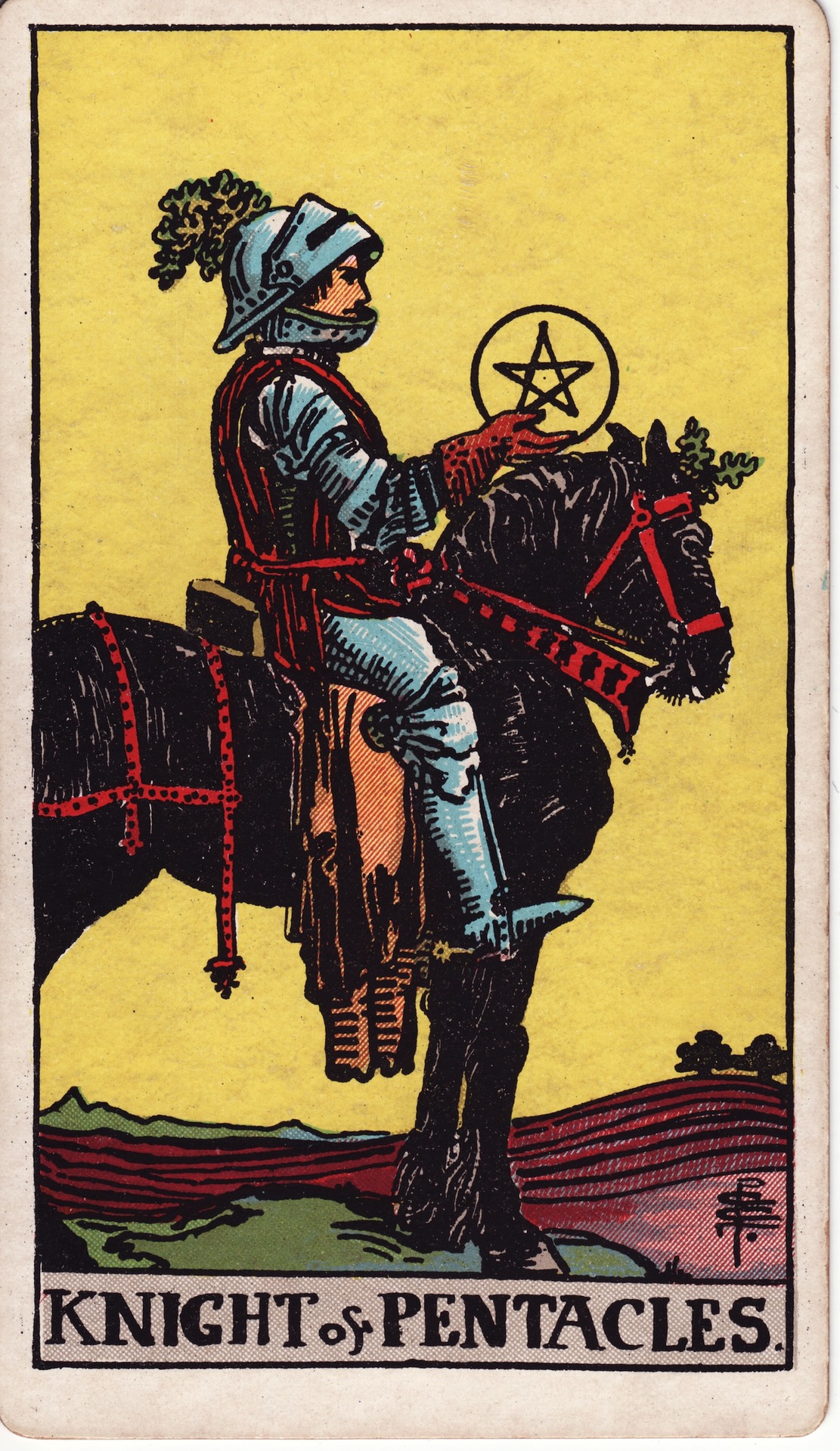
A knight in full armor sits on a heavy black horse that stands perfectly still. He holds a pentacle out in one gauntleted hand, but his gaze goes past it toward the distance. Sprigs of green leaves decorate his helmet and the horse's bridle, and the horse wears red harness. Behind them stretch freshly plowed fields in dark red furrows, with a few trees on a far hill under a yellow sky.
Waite wrote that he rides "a slow, enduring, heavy horse, to which his own aspect corresponds," and that he shows his symbol without looking into it.1 Knights are the movers of each suit, the ones who take what the Page only imagined and turn it into effort and obligation.2 This is the only knight whose horse is standing still, and the pause reads less as hesitation than as surveying the road before setting out.2 The furrows behind him were cut one at a time, a picture of someone content to make the same dull pass across a field for as long as the harvest requires.2
Upright
The Knight of Pentacles is the card of steady, dependable effort. He is not fast, and he is not flashy, but he finishes what he starts. Waite's meanings are utility, serviceableness, interest, responsibility, and rectitude, "all on the normal and external plane."1 This is the virtue of showing up every day and doing the work.
His strength is method as much as persistence. He decides where he is going, works out how to get there, and then holds to the plan down to small details, and he treats a promise or a half-finished task as a debt to be paid in full.2 When the card turns up for a plan already in motion, the advice is usually to leave it alone: the pace may feel slow, but the approach is sound and will get you there if you keep at it.2 That holds even when you are tired of it or feel an itch for something new; this is the knight who keeps going after the novelty has worn off.2
At work, the card favors routine, diligence, and patience: the project that will succeed through persistence, the job done carefully and on time, the reputation built on reliability. With money, it is a very conservative card: steady saving, a sensible budget, careful investment, and slow but certain growth. It advises against shortcuts and speculation. Sometimes it simply describes the plain business of keeping a life running, the chores, bills, and errands, and asks you to take them on without resentment.2
In love, the knight is loyal and committed, if not especially romantic. A relationship under this card grows slowly and stays; it may lack excitement, but it does not lack devotion. As a person, the card can represent someone methodical, hardworking, trustworthy, and cautious, who values routine and prefers proven methods to new ideas. An older reading Waite records calls him simply "a useful man."1 On the inner level, the knight asks you to commit to the long, unglamorous work that real results require, and to take satisfaction in getting it right.
Reversed
Reversed, the knight's steadiness turns to stagnation. Waite's reversed meanings are inertia, idleness, repose of that sort, stagnation, placidity, discouragement, and carelessness.1 The horse that stood still by choice is now simply stuck. Routine becomes a rut, and caution becomes a refusal to move at all.
A less common reading turns this around: the trouble is too little of the knight, not too much. If you keep starting new things and finishing none, the reversed card asks for the schedule and discipline the upright knight has, held until the job is actually done.2 It can also point to a personal project that depends on routine, such as a regular exercise habit or a change in diet, or to practical matters that have slipped while your attention went to more exciting things: the house, the accounts, a working relationship, the next step in a career. Whether to pull those back into focus now depends on what else is competing for your time.2
At work, this can mean boredom, a job with no progress, procrastination, or a project that has stalled because no one will take responsibility for it. It can also show the opposite failing: obsessive perfectionism or workaholism that sacrifices everything else to the job. That perfectionism can spill onto other people as impatience with anyone who cares less about details than you do, and it can cost you goodwill you will need later.2 With money, it can mean missed opportunities from too much caution, or carelessness with finances that were once well managed. An older reading Waite records is "a brave man out of employment."1
As a person, the reversed knight can be stubborn, dull, inflexible, or lazy, someone who resists change and avoids effort. It can also describe someone who has stopped taking any chances, who stays home while friends go out and slowly drifts out of their lives.2 When routine has begun to smother fresh ideas, the cure is a little spontaneity and permission to break your own rules now and then.2 In love, a relationship may feel stuck in routine, or a partner may be so focused on work or security that there is no warmth left. On the inner level, the card asks whether you are being patient or simply avoiding the next step.
Notes
- A. E. Waite, The Pictorial Key to the Tarot (1911), Knight of Pentacles, https://sacred-texts.com/tarot/pkt/index.htm
- Biddy Tarot, "Knight of Pentacles Tarot Card Meanings", https://www.biddytarot.com/tarot-card-meanings/minor-arcana/suit-of-pentacles/knight-of-pentacles/