Nine (9) of Pentacles
Appearance
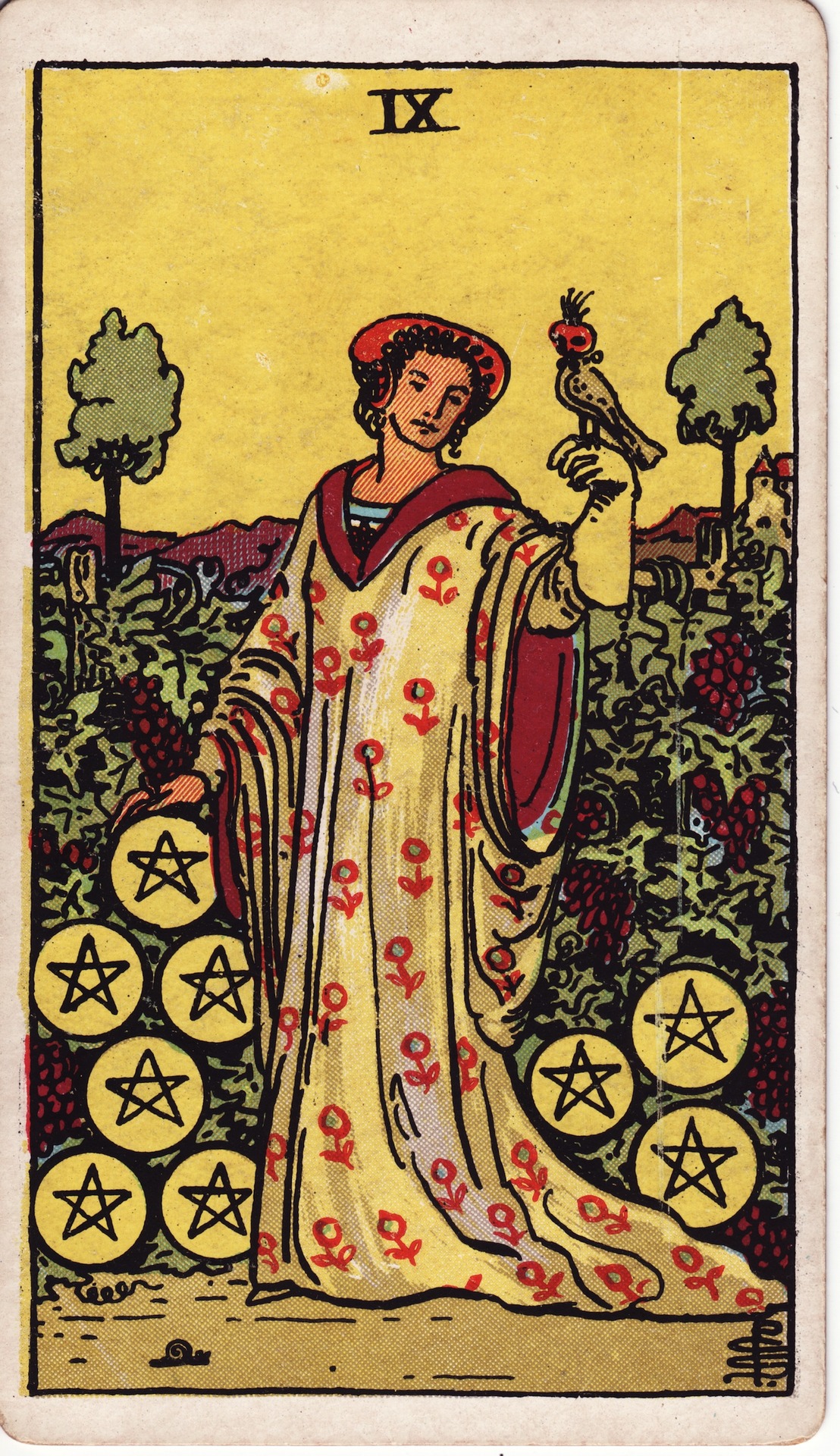
A woman in a long flowing robe stands alone in a vineyard heavy with ripe red grapes. Her gown is pale yellow and patterned with small red flowers, and she wears a red cap. On her raised gloved left hand perches a hooded falcon; her right hand rests on a stack of pentacles beside her. Six pentacles are piled on her right and three on her left among the vines. Behind her, under a yellow sky, stand two trees and, on the right, a manor house. A small snail crawls on the path at her feet.
Waite called the garden "a wide domain, suggesting plenty in all things," and thought it was probably her own possession.1 Nine is the last step before a suit's completion. In Pentacles, it is wealth that has been secured and can now be enjoyed. One hand touches the coins while the other reaches into the vines, and some readers take that gesture as an easy, unforced relationship with money: she handles it and savors what it brings, without grasping at more.2 The falcon sits quietly under its hood, a picture of self-command in thought and spirit as much as in habit.2
Upright
The Nine of Pentacles is the card of self-sufficiency and well-earned comfort. The woman stands alone, but she is not lonely; she has built this garden and can afford to enjoy it. Waite's meanings are prudence, safety, success, accomplishment, certitude, and discernment, the qualities of someone who has managed resources well and now reaps the reward.1
With money, it is a very good sign: financial independence, savings that give real freedom, a comfortable income, or the ability to spend on beauty and pleasure without guilt. It is a fair moment to mark a milestone with a real treat, something bought or done purely for yourself as thanks for the effort it took.2 Because nine is not yet ten, the card also suggests stopping short of the finish to take stock of how far you have come and rest before the last stretch.2 The independence it describes is meant to last, so it favors careful investing, good financial advice, and building a base that will look after you for years rather than leaning on anyone else's support.2 At work, it points to success earned through discipline, the freedom to set your own terms, or a project that has fully paid off. It can also describe the independence of self-employment.
In love, the card often speaks of someone whole on their own, who does not need a partner for security or self-worth. For someone single, it can be a time to enjoy independence; in a relationship, it suggests two people who each bring their own stability. The hooded falcon is often read as discipline and self-control, the trained wildness that makes this kind of freedom possible. On the inner level, the nine asks you to enjoy what you have built, and to recognize that your security is your own achievement. Less often noted is the garden itself: the card can point to a sense of being at ease in the natural world, and to pleasures as simple as tending plants, arranging flowers, or a long walk outdoors.2
Reversed
Reversed, the garden is under threat or its walls have become a cage. In the first form, financial independence is shaky: overspending, living beyond your means, a setback that undermines what you have built, or comfort that depends on someone else's support. In the second, self-reliance hardens into isolation, a life so carefully arranged that there is no room for anyone else.
Waite's reversed meanings are sharper: roguery, deception, voided project, and bad faith.1 With money, this can point to fraud, a scheme that collapses, or a partner or associate who is not what they seem. An older reading he records adds vain hopes, plans that look secure but will not come to pass.1
A quieter reading puts self-worth at the center. You may doubt that your work is worth what others are paid for it, and so undercharge, give your time away, or never ask for the raise.2 The remedy is to spend on yourself deliberately, through a new skill, a course, or simply some care you would normally talk yourself out of.2
At work, the reversed nine can mean overwork that leaves no time to enjoy the rewards, or success built on shortcuts that will not hold. Time away in open country, by water or among trees, is a good way to recover from that kind of grind.2 It may also be worth loosening your grip on a particular income or lifestyle if keeping it up is costing you time with the people you love; fewer hours and a leaner budget for a while can be a fair trade.2 In love, it can describe someone who values material comfort over intimacy, or who stays in a relationship for security alone. On the personal level, it asks whether your independence is real, and whether it has cost you more than it gave.
Notes
- A. E. Waite, The Pictorial Key to the Tarot (1911), Nine of Pentacles, https://sacred-texts.com/tarot/pkt/index.htm
- Biddy Tarot, "Nine of Pentacles Tarot Card Meanings", https://www.biddytarot.com/tarot-card-meanings/minor-arcana/suit-of-pentacles/nine-of-pentacles/