Page of Cups
Appearance
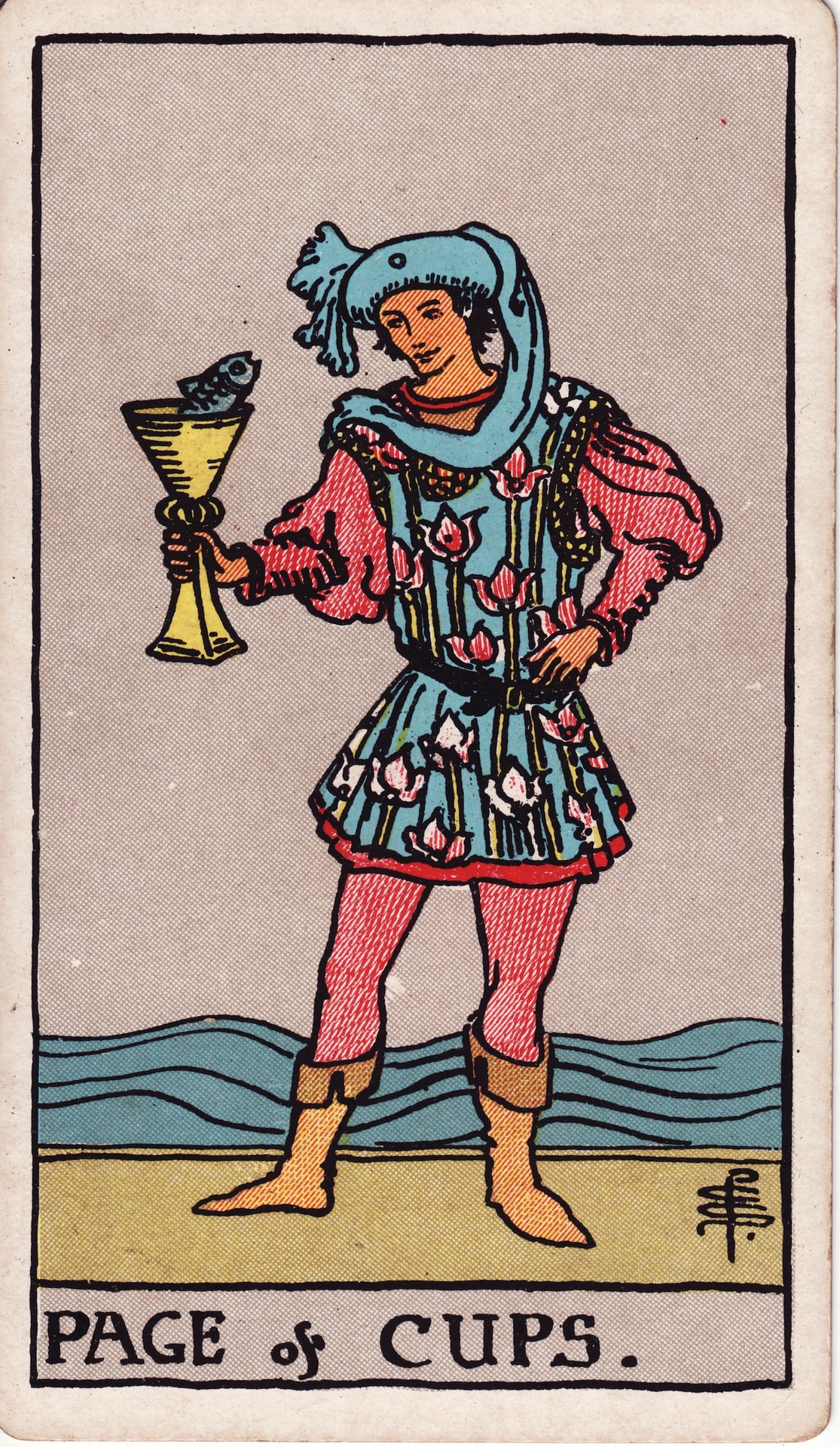
A young man stands on the shore with the sea rolling in behind him, one hand on his hip, holding out a golden cup in the other. A small fish rises from the rim of the cup and gazes up at him, and he regards it with a gentle, amused expression. He wears a blue tunic patterned with pink flowers, rose-colored sleeves and hose, and a blue cap with a long scarf that falls over his shoulder. The background is plain and pale, with only the waves to give it depth.
Pages are the students and messengers of the tarot, and in the suit of water they carry feeling and imagination. Waite described the page as "of studious and intent aspect," and called the fish "the pictures of the mind taking form."1 Fish and sea together stand for water's realm of emotion, intuition and creative life, and the fish turning up where no fish should be is a picture of how inspiration tends to arrive: without warning, and only to someone who is looking with an open mind.2
Upright
The Page of Cups brings messages of the heart: a creative idea that surfaces unexpectedly, an emotional offer, or news connected to love, friendship, or family. Like the fish in the cup, something surprising has appeared, and the card asks you to meet it with curiosity rather than skepticism. Waite's meanings are news and message, together with "application, reflection, meditation," and he adds "these things directed to business."1 Once an idea has landed in your cup, the real question is what you do with it; give it some time and attention, because an inspiration left alone has a way of being picked up and carried out by someone else.2
As a person, the page is a young or young-at-heart individual who is sensitive, imaginative and kind, more dreamer than doer, perhaps artistic or studious. Waite described a youth inclined to be of service to the querent.1 This may be a child, a new friend, or a younger colleague whose openness brings warmth.
In love, the card favors a sweet beginning: a crush, a confession, an invitation, or the announcement of an engagement or pregnancy. These pleasant surprises cannot be arranged or hurried; the task is to be ready when they come.2 At work, it suggests creative opportunity, an unexpected offer of a project, and the early stage of an artistic or caring career, along with good news about an application. Money is not its focus, but an idea born here may lead somewhere practical. Waite's later notes call the card a good augury.1
Inwardly, the page invites you to trust intuition, follow small impulses toward beauty or play, and let your inner child have a say. Like every page it marks the start of a study, here of your own emotional and creative side: taking up a painting class, reading about how to put feelings into words, or working on your intuitive skills. You may find yourself touched by small things, and the card says there is no need to hide it.2 Pay attention to coincidences and quiet signs, even ones that make little sense at first; following one hint tends to reveal the next, and a trail of them can lead somewhere you are glad to be.2
Reversed
Reversed, the Page of Cups can show emotional immaturity: moodiness, oversensitivity, sulking when things do not go one's way, or retreating into fantasy instead of dealing with what is real. Creative ideas may stall, or remain daydreams that never reach the page. Waite's reversed meanings begin mildly with "taste, inclination, attachment," and then turn sharper: "seduction, deception, artifice."1
Not every reversal is a problem, though. The card can simply mean an idea you are keeping to yourself for now, shielding it from people who might borrow it or talk you out of it, and letting it take shape before anyone else sees it. That can be wise until the plan is more than a concept.2 More often, the trouble is doubt. You feel drawn to a creative project but your inner critic, or friends who call it a pipe dream, keep you from starting. It helps to ask plainly what a failure would actually cost, and to weigh that against years of wondering what might have happened, or against the chance that it works.2 At times the block is deeper: some part of you wants expression, yet you question whether your work has any worth, or the ideas are plain to you but you cannot see how to bring them out into the world.2 Those developing their intuition may find themselves second-guessing every impression, unsure whether it is real guidance or their own wishes talking.2
As a person, the reversed page can be someone charming but unreliable, whose feelings change quickly or who uses sweetness to get what they want. It can also be someone theatrical who shares too much too soon, or an adult who refuses to grow up and keeps living in daydreams about the future.2 In love, it may point to an infatuation that will not last, a crush on an idealized image, or messages that promise more than the sender intends to deliver. Waite's later notes add obstacles of all kinds.1
At work, the reversal warns against impractical plans, or against taking criticism too personally. Inwardly, the advice is to stay open but grounded: notice the feelings that surface, and check them against the facts before acting on them.
Notes
- A. E. Waite, The Pictorial Key to the Tarot (1911), Page of Cups, https://sacred-texts.com/tarot/pkt/index.htm
- Biddy Tarot, "Page of Cups Tarot Card Meanings", https://www.biddytarot.com/tarot-card-meanings/minor-arcana/suit-of-cups/page-of-cups/