Seven (7) of Pentacles
Appearance
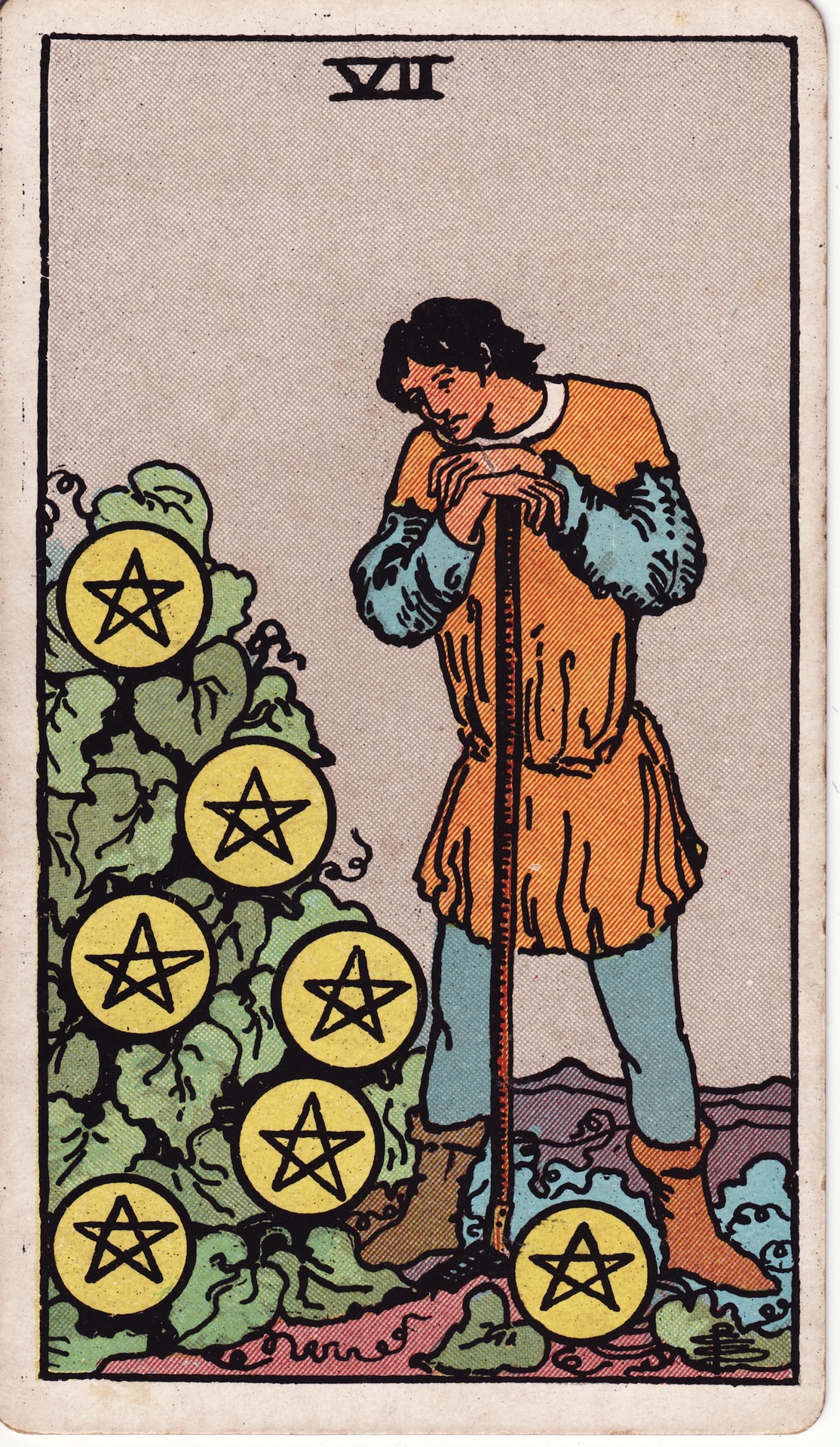
A young man in an orange tunic and blue hose leans with both hands folded on top of a long staff, likely a hoe, resting his chin on them. He gazes at a tall green bush beside him, its broad leaves heavy with six pentacles growing like fruit. A seventh pentacle lies on the ground near his feet. He stands on bare earth, and his expression is hard to read: tired, thoughtful, perhaps a little doubtful.
Waite wrote that "one would say that these were his treasures and that his heart was there."1 The weariness in his posture matters too. He has brought the bush this far by steady labor, and he looks less like a man admiring his crop than one who has worn himself thin raising it, a reminder that patience and hard work can tip into exhaustion.2 Seven is often read as a number of assessment and of pausing between effort and result. In the suit of earth, the pause comes in the middle of a growing season, when the work is done but the harvest has not yet been gathered.
Upright
The Seven of Pentacles is the card of patient investment and of stopping to take stock. Much effort has gone into something, and it is beginning to show results, but not yet enough to say whether the work has paid off. The card asks you to step back from the daily grind, look at what has grown, and decide whether to keep tending it, change your approach, or move your effort elsewhere. Part of that review is simply acknowledging what you have already built before asking whether you are still aimed at the right goal.2 The mindset it describes is one that would rather build something durable than grab an early win.2
With money, it describes long-term investment: savings that grow slowly, a business that needs more time before it turns a profit, or a return that is coming but cannot be rushed. Waite calls it in the main a card of money, business, and barter.1 At work, it fits a project at its midpoint, a career built over years, or a performance review where you weigh what you have achieved. If you have been pushing hard on something demanding for months, the card can also mean the end is near and the payoff, often a concrete or financial one, is on its way.2 When planning ahead, it asks you to sort the commitments that return something from the ones that only drain you, and to put your effort where it will count most.2 In love, it can mean a relationship that has had real effort put into it, where the question is whether that effort is being returned and whether the future looks worth working toward.
Waite notes that the card's meanings are contradictory, with one reading giving quarrels and another innocence and ingenuity.1 On the inner level, it is a card of patience: trusting slow processes, judging results honestly, and remembering that growth has its own pace. It can also show the impatience of someone who fears all that work will come to nothing. Here the advice is to count the progress already made, ask whether your timeline was ever realistic, accept that nothing is promised, and work with what is in front of you.2
Reversed
Reversed, the patience runs out or the work does not pay. Effort has been poured into something that is not growing, and frustration or impatience sets in. This can be the investment that underperforms, the job that offers no advancement, or the project that keeps consuming time with nothing to show for it. Money may go out early on things that never produce anything, or a goal you expected to bring contentment may be bringing only strain.2 The fix is triage: list what still has to be done, weigh what each task costs against what it returns, and drop the routine habits that eat hours without moving anything forward.2
Sometimes the card asks you to cut your losses; sometimes it warns that you are about to abandon something just before it bears fruit. Read kindly, the reversal can even be a strength: the ability to walk away from a losing effort instead of staying in it only because so much has already been spent, and to try something else without treating that as defeat.2
Waite's reversed meaning is specific: cause for anxiety regarding money which it may be proposed to lend.1 Be cautious about lending, borrowing, or co-signing, and read the terms closely. An older reading he records adds impatience, apprehension, and suspicion.1
In love, it can mean feeling that you give more than you receive, or growing restless in a relationship that seems to have stopped developing. There may be fear of losing the groundwork you have laid together, or a slow recognition that no amount of further effort will make this relationship what you need.2 On the inner level, the reversed seven can point to scattered effort, working hard on too many things to let any of them mature, or to impatience that demands a harvest before the season allows one.
Notes
- A. E. Waite, The Pictorial Key to the Tarot (1911), Seven of Pentacles, https://sacred-texts.com/tarot/pkt/index.htm
- Biddy Tarot, "Seven of Pentacles Tarot Card Meanings", https://www.biddytarot.com/tarot-card-meanings/minor-arcana/suit-of-pentacles/seven-of-pentacles/