Ten (10) of Wands
Appearance
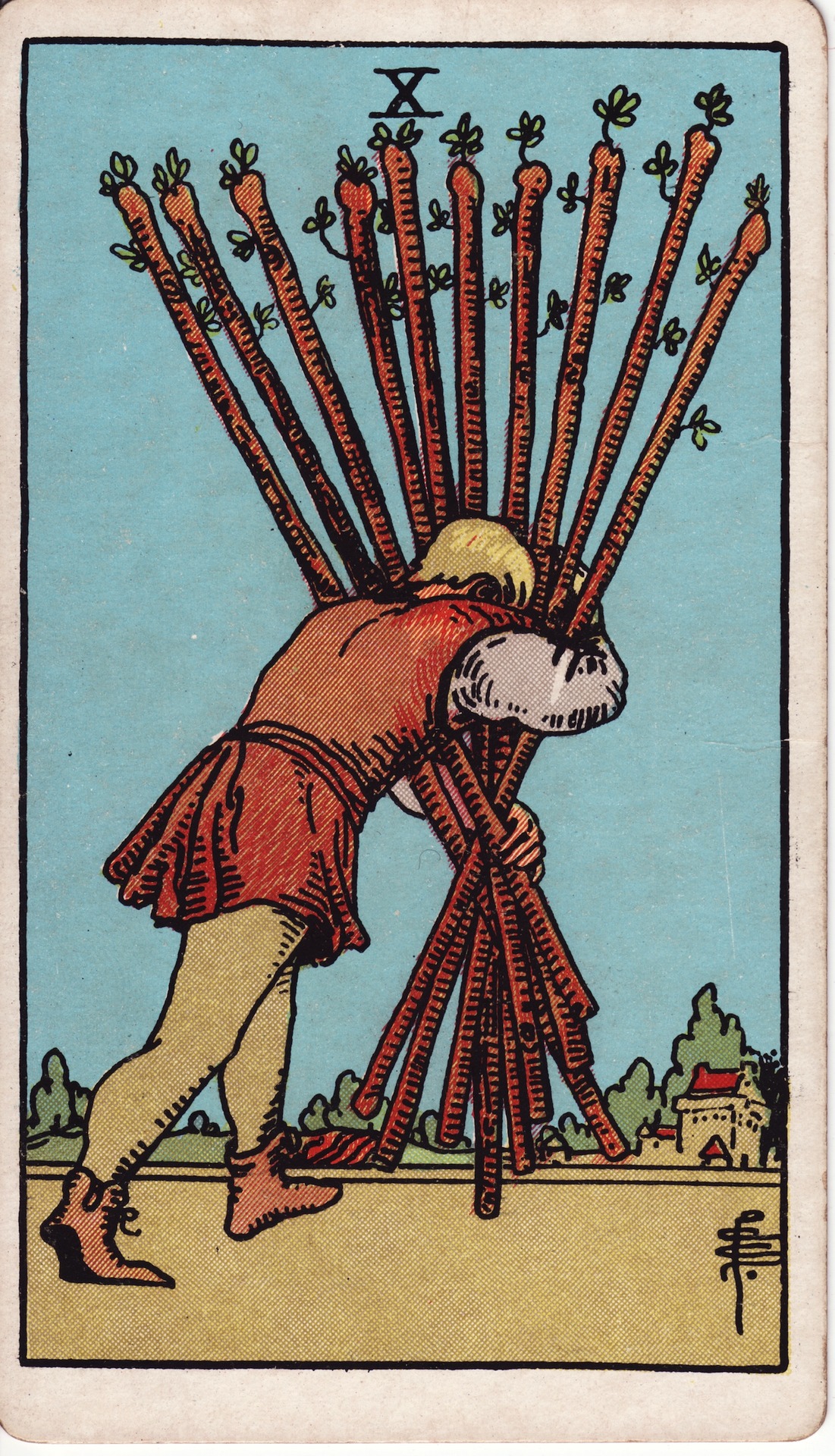
A man bends forward under the weight of ten wands, carrying them gathered in his arms in a tight bundle. They are held so close against his face that his head is nearly hidden among them, and he cannot see where he is going. He walks across flat ground toward a house with a red roof among the trees on the right, which seems to be his destination. He wears a short red tunic and pale leggings, and his whole posture is strain.
Tens complete a suit, sometimes to excess. Waite called this a card of many meanings, some of which cannot be harmonized, but described the picture plainly: a man oppressed by the weight of the ten staves he is carrying.1 The house is not far off, though. He has done most of the walk already, and a few more steps will let him drop the load, so the picture holds both the strain of the moment and the end of it.2
Upright
The Ten of Wands is the card of burden. The fire that began with the Ace has grown into responsibilities, commitments, and obligations, and now you are carrying all of them at once. Waite's chief meaning is oppression, but he added that it can also be fortune, gain, or success, and then the oppression of these things: the weight that comes with having succeeded.1
Not every load here is a mistake. Sometimes you pick it up on purpose, knowing it will not last: the overtime that pays for a trip, a weekend hauling boxes for a friend who will help when your turn comes, the months of looking after a parent who is ill. The card then describes effort spent willingly now for something you value later.2 As the last card of the suit, it can also mean the long push is nearly over, and that arriving will leave you tired but with something earned.2
At work, it describes overload: too many projects, too much responsibility, saying yes to everything, or being the one everyone depends on. Often the pile grew without your noticing. The advice is to stop, sort what is truly urgent from what only feels that way, measure each task against the larger goal, drop what does not serve it, and leave room to rest.2 Success itself can be the trap: the founder whose company thrives but who will not hand anything off, and who ends up working every waking hour on something that once excited them. When the spark that started a venture turns into pure grind, giving away part of the load is how you get the enjoyment back.2 With money, it can mean financial obligations that weigh heavily, or wealth that brings its own demands.
In love, it can point to a relationship that feels like work, one partner doing most of the emotional or practical labor, or outside pressures such as family, money, or careers crowding out closeness.
On a personal level, the card asks why you are carrying so much. Sometimes it is necessity; often it is habit, pride, or the belief that no one else will do it right. The load becomes lighter once you can see past it.
Reversed
Reversed, the burden either comes off or becomes too much. In the lighter reading, you are finally setting things down: delegating, saying no, letting go of duties that were never yours, or finishing a heavy stretch of work. Relief is close. This can be quite practical, a deliberate review of what in your life gives nothing back, down to emptying closets and selling furniture you no longer use, after which everything feels simpler.2
In the heavier reading, the weight has become crushing. Burnout, collapse, or the sense that you can no longer go on in the same way are possible, and the reversal can mark a breaking point. Often the cause is trying to meet everyone's needs at once; if you do not look after your own health first, you will soon be no use to the people relying on you.2 At work, this may look like dropping responsibilities without a plan, or refusing help long past the point of good sense. In relationships, one partner may be exhausted from carrying things alone, and resentment may be building.
The reversal can also mean a burden kept hidden. Grief, an old injury, a secret, or a private worry is being carried without a word to anyone, and that silence holds off the very people who would gladly help. Telling someone may bring more relief than you expect.2 Some of what you carry may not need carrying at all: worry over things that are not your business or cannot be changed, or a quiet sense that suffering alone is what a good person does.2
Waite's reversed meanings are contrarieties, difficulties, intrigues, and their analogies: complications that may come from other people rather than from the load itself.1 Be alert to those who add to your burden while appearing to help. Whatever the cause, the card asks you to look at what you are holding and choose what to keep.
Notes
- A. E. Waite, The Pictorial Key to the Tarot (1911), Ten of Wands, https://sacred-texts.com/tarot/pkt/index.htm
- Biddy Tarot, "Ten of Wands Tarot Card Meanings", https://www.biddytarot.com/tarot-card-meanings/minor-arcana/suit-of-wands/ten-of-wands/