The Chariot (VII)
Appearance
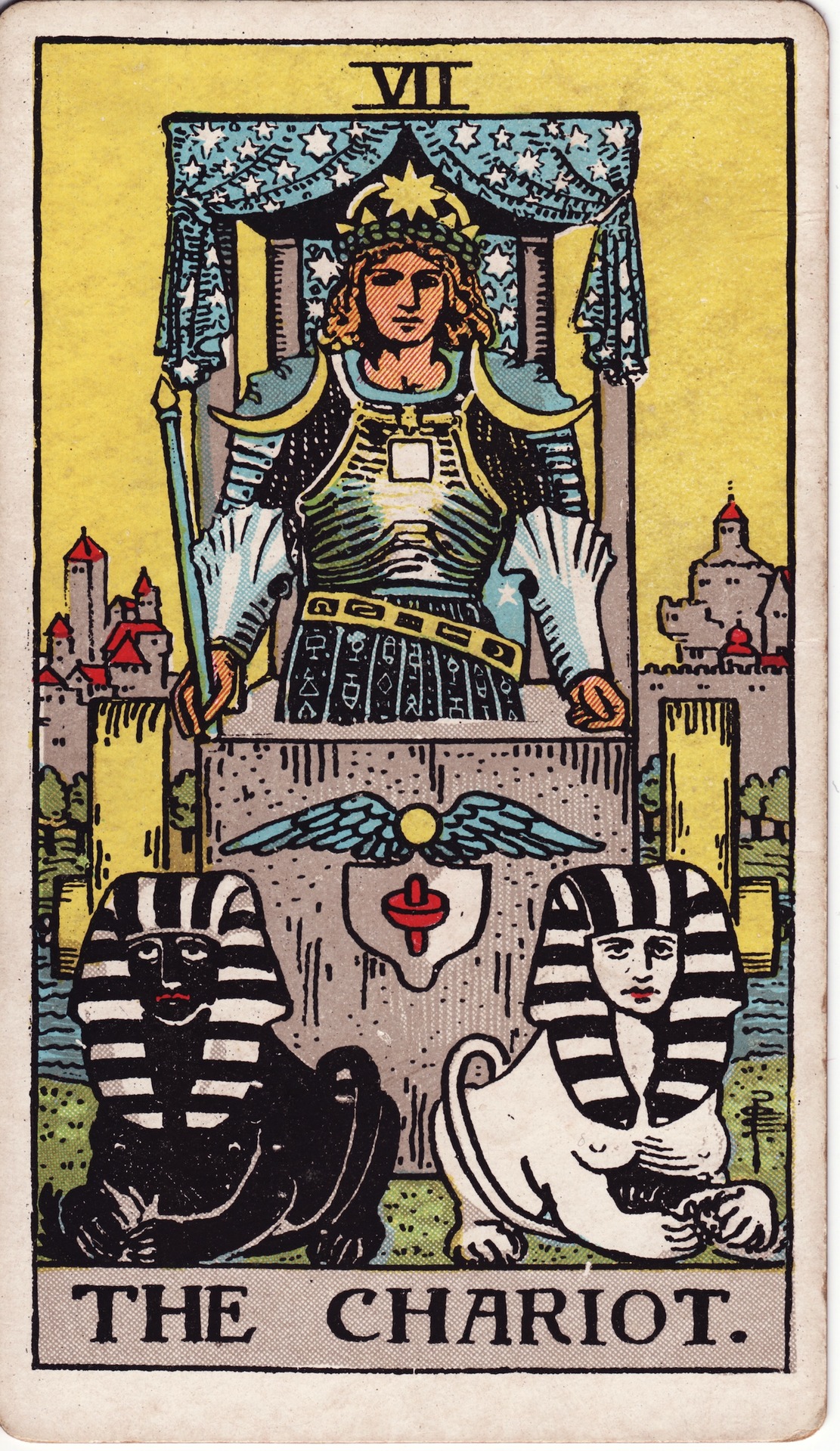
A young man in armor stands in a square stone chariot beneath a blue canopy of stars. He wears a wreath and a crown set with an eight-pointed star, crescent moons sit on his shoulders, and a square is set into his breastplate. He carries a wand and holds no reins. In front rest two sphinxes, one black and one white. On the chariot's front is a winged sun disk above a red emblem, and behind him a river runs past a walled city.
Waite's text gives the charioteer a drawn sword, though Smith drew a wand. Following Eliphas Levi, Waite replaced the horses of older decks with sphinxes, and he called the card "above all things triumph in the mind."1 The crescents suggest things coming into being, the square firm resolve, and the wreath and star a win that is also growth. His wand echoes the Magician's, so he steers by intention, and he stands, ready to move. The river behind him is a reminder to keep pace with the current of life even while driving forward.2
Upright
The Chariot is the card of victory through willpower and control. It shows forces that pull in different directions, the black and white sphinxes, held together by a driver who uses no reins, only focus. Waite's meanings include succor, providence, war, triumph, presumption and vengeance.1 The core message is that determination and self-discipline can carry you through a contest, and that progress comes from choosing a direction and holding it. In the sequence of the major arcana it follows the Lovers: the decision has been made according to what you value, and now it is time to act on it. When it turns up in a reading it is usually encouragement, and a nudge that waiting for things to sort themselves out will not work here.2
The road is rarely smooth. Expect to be tested, by your own divided impulses and by people who try to slow you down or pull your attention elsewhere. The card promises success on the condition that you stay on course, keep faith in your own ability, and do the work in full; shortcuts tend to undo it. It also asks you to speak up: say plainly what you want, set limits where you need them, and be clear with yourself about your own identity and the principles you will not trade away.2
At work, the Chariot favors ambition, competition and success won by effort: a hard-fought promotion, a project driven to completion, a win in negotiations or in a legal dispute. It also favors travel, especially a journey connected with work or a move, and quite literally a long drive or a road trip.2 With money, it suggests progress through focus and disciplined spending rather than windfalls. In love, it can describe pursuing what you want with confidence, working through a difficult patch together, or two very different people learning to move in the same direction. It may also warn that a relationship is being treated as something to win.
Inwardly, the card is about mastering conflicting impulses. Waite noted that the charioteer's conquests are external, not within himself; the victory is real, but it is a victory of will, and the inner work may remain undone.1
Reversed
Reversed, the Chariot loses direction or control. The sphinxes pull apart, and effort scatters: too many goals at once, plans undone by obstacles, or the frustration of pushing hard and going nowhere. At work, this can mean a stalled project, a lost competition, or ambition that outruns preparation. With money, impulsive moves can undo what discipline built. Sometimes the right response is not more force but a turn: the resistance may be a sign that the route is wrong, and it is worth asking what the difficulty is trying to teach before pressing on.2
In its excess form, the reversed Chariot is force without restraint: aggression, a need to win every argument, steamrolling others to reach a goal. In relationships, it can describe power struggles, one partner trying to steer everything, or two people whose aims have diverged. It can also point to a lack of willpower, giving up too soon, letting other people's doubts talk you out of a goal, or simply finding that the drive you began with has gone. Remembering why the goal mattered in the first place is often what restarts it.2 A quieter reading treats the reversal as the inward half of the card: before the next push, the work is in private, on discipline, intention and the kind of mental rehearsal that leaves you ready when it is time to move.2
Waite's reversed meanings are riot, quarrel, dispute, litigation and defeat.1 Conflict that was contained in the upright card breaks into the open. The advice is to stop, check the map, and decide what you actually want before pushing on; sometimes regaining control means slowing down rather than pressing harder. Sort what is yours to change from what is not, and put your effort only into the first. The opposite problem also shows up here: trying to manage every small detail until life feels even less manageable. Then the cure is to ease off, accept the help on offer even if it is not quite what you pictured, and let someone else drive for a while.2
Notes
- A. E. Waite, The Pictorial Key to the Tarot (1911), The Chariot, https://sacred-texts.com/tarot/pkt/index.htm
- Biddy Tarot, "The Chariot Tarot Card Meanings", https://www.biddytarot.com/tarot-card-meanings/major-arcana/chariot/