The Devil (XV)
Appearance
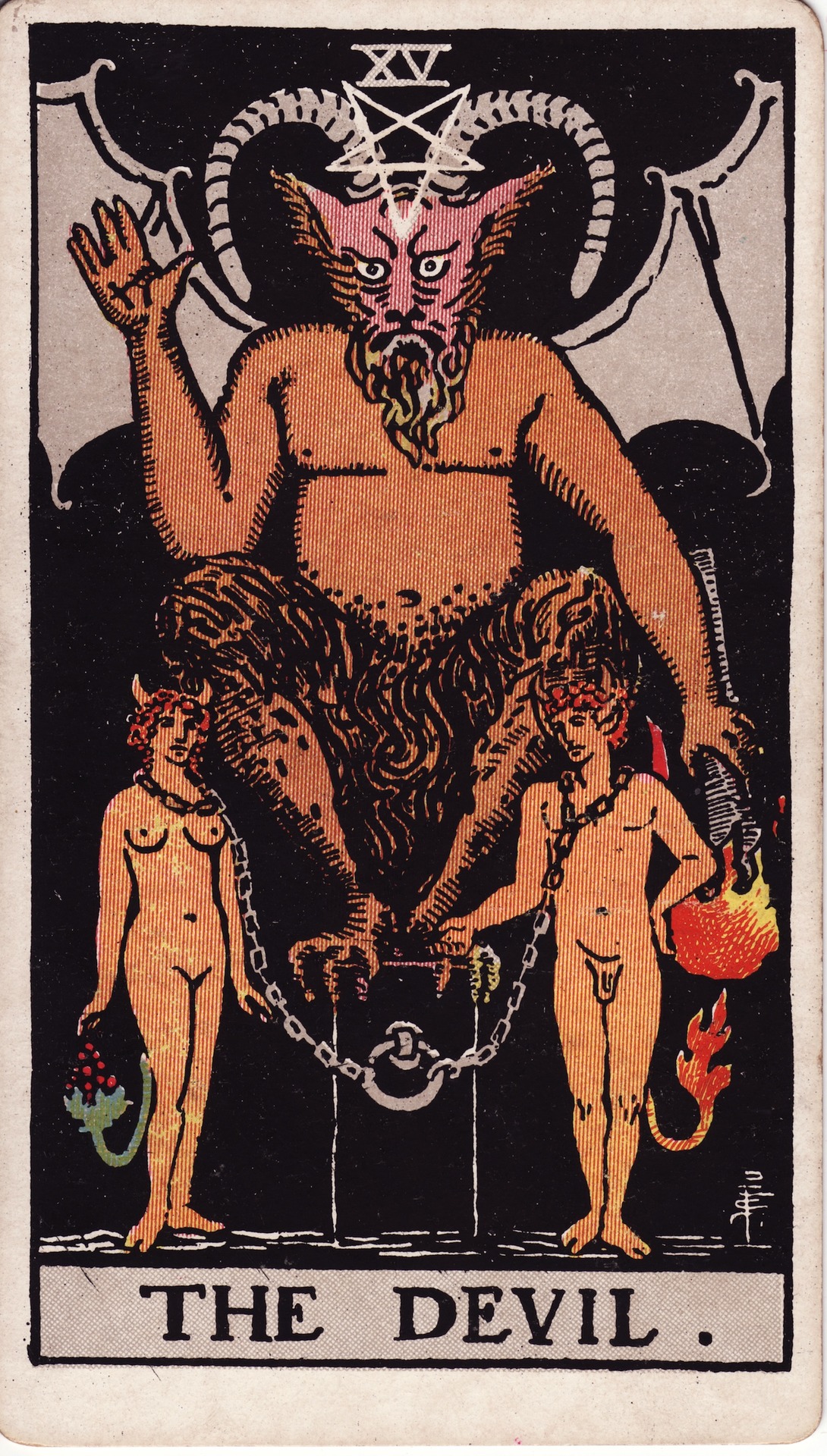
A horned creature with the head of a goat and the wings of a bat squats on a black half-block, against a black background. An inverted pentagram is set above his brow. His right hand is raised with the palm open, and his left holds a flaming torch pointed down toward the ground. Chained to a ring on the front of the block stand a naked man and woman, each with small horns. The man's tail ends in a flame and the woman's in a cluster of grapes. The chains hang loosely around their necks.
Waite described the raised hand as the reverse of the blessing given by the Hierophant, and called the chained pair Adam and Eve after the Fall: an image of "the chain and fatality of the material life." He added that the figure above them is not to be their master forever.1 The figure echoes Baphomet, once a joining of opposites, human and beast, male and female, before he became the face of everything forbidden. Bat wings suggest appetite that drains whoever feeds it. The pair's horns hint they grow more like him the longer they remain; the fire and grapes mark lust and indulgence.2
Upright
The Devil is the card of attachment and of feeling bound. Something has a hold on you: a habit, an addiction, a relationship, a debt, a job you stay in only for the money, or a fear that dictates what you do. Usually the bargain is pleasure now against cost later. Like the Lovers, this is a card of choice, but here the choice keeps landing on the quick reward at the expense of long-term well-being.2 The card's key detail is that the chains are loose. Much of the captivity is accepted rather than enforced, and the belief that you could never get free is itself part of the trap.2 Waite's meanings are harsh, ravage, violence, vehemence, force, fatality, though he adds that what is fated here is not for that reason evil.1
In love, it can describe intense physical attraction and obsession, or a relationship held together by dependency, jealousy or control rather than affection. It is not always a warning: it can show a bond of unusual strength, the absorption of new lovers or of a parent with a newborn, which stays healthy only while each person keeps their own boundaries and judgment.2 It can also speak of sexuality and exploring a wilder side, rewarding with trust and agreed limits and risky without them.2 At work, it points to feeling trapped, golden handcuffs, overwork driven by fear, or a situation that takes far more than it gives. With money, watch for debt, compulsive spending, or a preoccupation with material security that crowds out everything else.
The inner reading is about the shadow: appetites, impulses and patterns you would rather not look at. The Devil does not demand that they be destroyed, only that they be seen honestly. Admitting the hold plainly, the way recovery programs begin with an admission of powerlessness, is where release starts. As a Major Arcana card it seldom describes a pattern that lifts overnight; expect it to return and to need sustained effort, though the way out is real.2 Once you know what is holding you and why, you can decide whether you want it to.
Reversed
Reversed, the Devil most often shows release. You recognize the chain for what it is and begin to lift it off: breaking a habit, leaving a controlling relationship, paying down a debt, walking away from work that was costing too much. The change may be as ordinary as eating better, giving up cigarettes, or handing your evenings back to the people you love. It often comes just before a step up in life, when growing into something larger means dropping old attachments first.2 The process may be slow and uneven, but awareness has arrived and the hold is weakening.
The reversal can also point inward, to facing parts of yourself you have kept hidden and finding they have less power once named. That descent may be chosen, made on purpose to release or put to use what is found, or it may come unbidden and feel like meeting a stranger, bringing anxiety, low mood or dark thoughts; then a good therapist is worth finding.2 Secrets held out of shame tend to grow heavier, and telling one trusted person, along with forgiving yourself, can lighten them.2 In love, it can mean a relationship freed from jealousy or dependency, or the end of one that was built on them. A useful aim is detachment in the Buddhist sense: still caring for people and things, but no longer needing them in order to feel whole.2
There is a harder form too. Waite's reversed meanings are evil fatality, weakness, pettiness and blindness: the bondage deepening rather than loosening, a person so used to the chain that they no longer notice it.1 A brief escape may be followed by relapse, or one compulsion may be swapped for another. If this is the reading, be honest about what has really changed, and look for practical support, people and structures that make the freedom last rather than relying on willpower alone.
Notes
- A. E. Waite, The Pictorial Key to the Tarot (1911), The Devil, https://sacred-texts.com/tarot/pkt/index.htm
- Biddy Tarot, "The Devil Tarot Card Meanings", https://www.biddytarot.com/tarot-card-meanings/major-arcana/devil/