The Fool (0)
Appearance
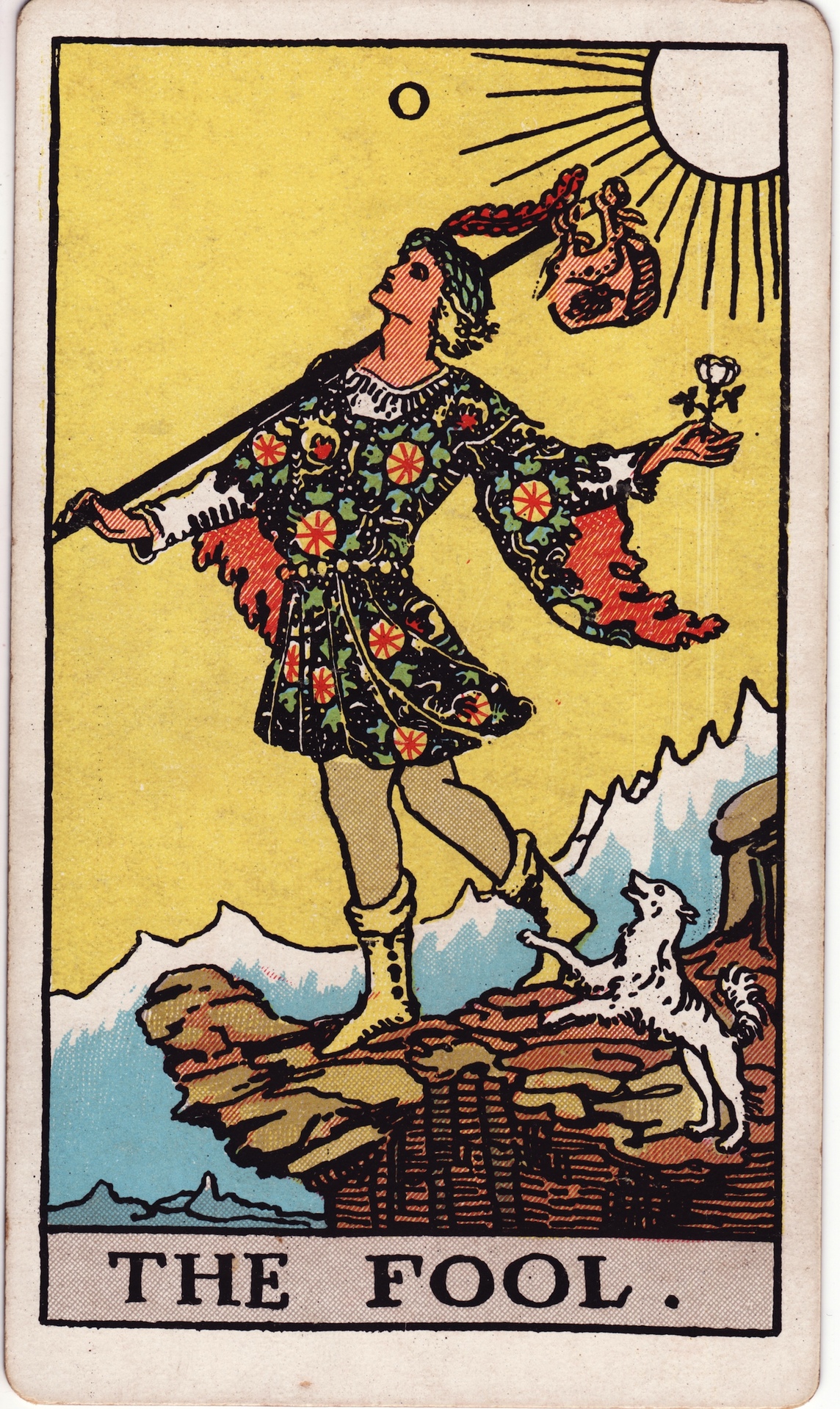
A young man stands at the very edge of a cliff high in the mountains, mid-stride, with his face turned up toward the sky rather than down at the drop in front of him. He wears a flowered tunic, yellow boots, and a cap with a red feather. A staff on his shoulder carries a small bag, and in his other hand he holds a white rose. A little white dog jumps at his heels, either warning him or urging him on. Behind him a white sun hangs in a yellow sky, and snowy peaks rise in the distance.
The bag is tiny for a long road, so he carries only what he needs; the rose is his innocence, the dog a loyal guard, and the far mountains the climbs still ahead, which he is not thinking about yet.1
The card is numbered zero. In older decks the Fool was a ragged vagabond outside the trumps altogether. Waite and Smith made him a traveler at the start of the road: in Waite's words, the spirit in search of experience.2 Zero also lets him sit at either end of the major arcana, or walk through all of it.1
Upright
The Fool marks a beginning that has not yet been tested by anything. Something new is asking for a yes before you can see where it leads: a move, a change of direction, a project, a relationship, a first step in an unfamiliar place. The card does not promise the ground will be there. It says the moment favors openness over caution, and that waiting until every risk is mapped would mean not going at all. Nor does it ask you to wait for permission, or for a full kit of skills and savings; like the figure with his little bag, you can set out with the essentials and pick up the rest along the way.1
In love, it points to freshness and spontaneity. A new romance may begin unexpectedly, or an existing relationship may feel light and adventurous again. For someone single, it favors saying yes to the invitation, the trip, the stranger, without deciding in advance what it has to become. At work, it is the card of the new job, the career change, the venture started on enthusiasm and very little else, and of travel. With money, it allows a measured risk on something you believe in, but Waite's older readings of folly and extravagance are a fair reminder that the same impulse that opens doors also spends freely.2
On a deeper level the Fool stands at the start of the whole journey through the major arcana. Innocence here is not stupidity but a lack of armor: curiosity, trust, and the willingness to learn by doing. The card also asks for play. Approaching the coming stretch as an experiment, with the kind of wonder a child brings to a new place, tends to work better than grim planning.1 For anyone weighed down by worry or self-doubt, the Fool is a good image to sit with in meditation: he does not pretend the fear is absent, he notices it and steps anyway, trusting that what he needs will turn up.1
Reversed
Reversed, the leap goes wrong in one of two directions. The first is recklessness: acting without looking, ignoring the warnings your friends or your own sense are giving you, treating a real cliff as if it were scenery. Waite's reversed meanings run toward negligence and carelessness, and this is the version of the Fool who misses details, overcommits, or chases novelty for its own sake.2 Living for the moment can also put other people at risk, so the question becomes how to keep the free spirit without making others pay for it.1 In money and work, check the plan before you sign; a venture that looks freeing may simply be under-prepared.
The second is the opposite: the leap never happens. Fear of the unknown, a need for guarantees, or the weight of what others might think keeps you at the edge long after the moment has passed. Often there is already an idea fully formed, but you doubt you have the ability or the means, or feel the timing is off, and so it stays private or is set aside for later.1 Underneath that stall is frequently a wish to control every outcome before acting at all.1 In love, this can look like hesitating to commit, holding a new connection at arm's length, or, from the other side, rushing in so fast that nothing has room to grow.
The reversed Fool can also mean naivety that someone else takes advantage of. Keep the openness, but add a little judgment: ask what you actually know, decide what you can afford to lose, and then choose whether to step. A gentler reading is that the Fool's playfulness has simply turned inward. You may be enjoying it in private, away from any audience, and that is a fine place to start letting more of it into ordinary days.1
Notes
- Biddy Tarot, "The Fool Tarot Card Meanings", https://www.biddytarot.com/tarot-card-meanings/major-arcana/fool/
- A. E. Waite, The Pictorial Key to the Tarot (1911), The Fool, https://sacred-texts.com/tarot/pkt/index.htm