The Hermit (IX)
Appearance
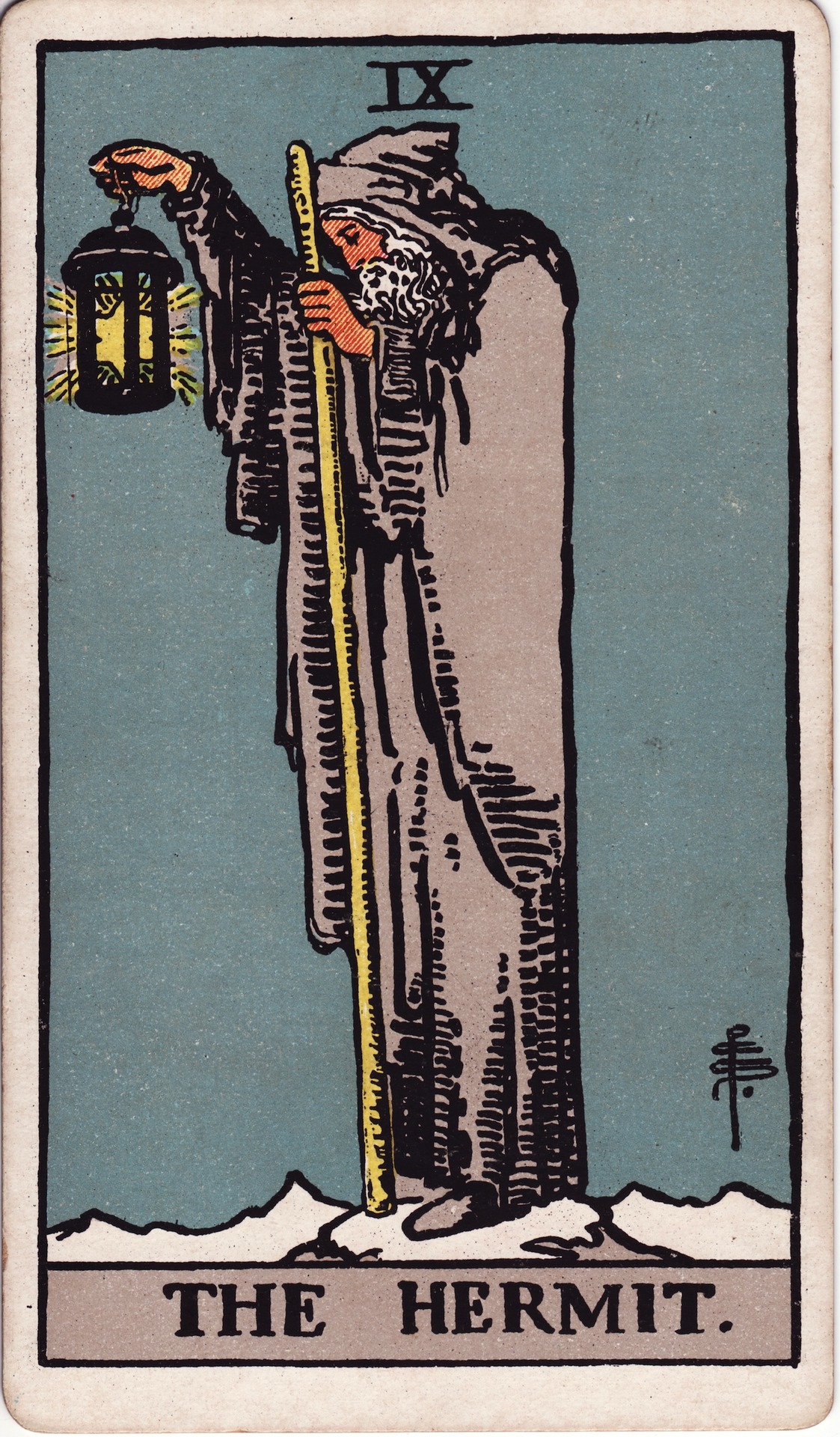
An old man in a long gray hooded cloak stands alone on a snowy mountain peak against a plain blue-gray sky. He has a long white beard, and his eyes are lowered. His right hand lifts a lantern; the six-pointed star burning in it lights only a short way. His left hand grips a tall yellow staff. Nothing else is in the scene: no path, no companion, only snowy ridges below.
In early Italian decks this figure was often an old man with an hourglass, a picture of Time. Waite noted that older designs showed the lamp partly hidden in the Hermit's mantle; here it is held up openly, as a beacon on a height.1 He rejected the idea that the card meant occult isolation and read the light instead as a sign that "where I am, you also may be."1 The peak can be read as a summit he chose to climb, a measure of how far his inner work has taken him.2 The star is often called the Seal of Solomon, an emblem of wisdom, and the staff, held on the left, the side tied to the unconscious, marks his standing and steadies his footing.2
Upright
The Hermit is the card of withdrawal for the sake of understanding. It asks for solitude, reflection, and a pause from the noise of other people's opinions so that you can find your own answer. Waite's meanings begin with prudence and circumspection, careful attention before acting, though his list also includes, oddly, treason and dissimulation.1 The light in the lantern is small, enough for the next few steps, and the card suggests that this is all you need for now: you see the path by walking it, one step and then the next.2
The card often turns up at a crossroads, when an old direction no longer fits and a new one has not yet come clear. Time spent alone with the question tends to shift your priorities, as you look again at what you value and why you do what you do. A retreat, a long solo walk, or a few days away can serve, and the company, if any, should be small and of a like mind.2 For some, the card is also a turning away from getting and spending toward a simpler, more inward life.2
In love, the Hermit often points to a period alone, by choice or circumstance, used to understand what you really want. In a relationship, it may describe a partner who needs space, or a couple who are quieter and more inward for a time; it does not have to mean coldness. At work, the card favors study, research, specialist knowledge, and careful planning over networking and quick moves. It can also describe seeking out a mentor, or becoming one, and the best such teacher does not hand over answers but shows you how to find them yourself.2 With money, it advises caution and reflection before any major commitment.
On the deeper level the Hermit is a seeker who has found something and holds it up for others. Waite stressed that this is a card of attainment, not mere retreat: the solitude has a purpose, and the light is meant for anyone who climbs far enough to see it.1
Reversed
Reversed, the Hermit's solitude goes wrong in one of two ways. The first is too much of it: isolation that has stopped being useful, loneliness, withdrawal from friends and partners, or a retreat into your own head that becomes a hiding place. Inner work can turn into self-absorption, so that the people who rely on you get crowded out by your own concerns.2 At work, it may be a lone-wolf approach that leaves you without support or influence.
The second is too little: an inability to be alone, filling every quiet moment with distraction, and avoiding the reflection a situation needs. Daily demands can drown out your own sense of purpose until you no longer know what you are working toward, and the card asks you to make room to recover it.2 Decisions, including financial ones, get made on impulse or on borrowed advice, because stopping to think feels uncomfortable.
In relationships, the reversal often shows a mismatch: one person pulls back while the other wants to come closer, and both have to honor the need for space without abandoning each other. It can also show a couple holding on mainly because being single feels too frightening right now, or, after a parting, a willingness to try again.2
Waite's reversed meanings are concealment, disguise, policy, fear, and unreasoned caution.1 Here prudence has hardened into suspicion and secrecy, or caution has become an excuse for never moving. The advice is to find a middle course: take the time you need to think, then come down from the mountain and rejoin the people you care about.
Notes
- A. E. Waite, The Pictorial Key to the Tarot (1911), The Hermit, https://sacred-texts.com/tarot/pkt/index.htm
- Biddy Tarot, "The Hermit Tarot Card Meanings", https://www.biddytarot.com/tarot-card-meanings/major-arcana/hermit/