The Hierophant (V)
Appearance
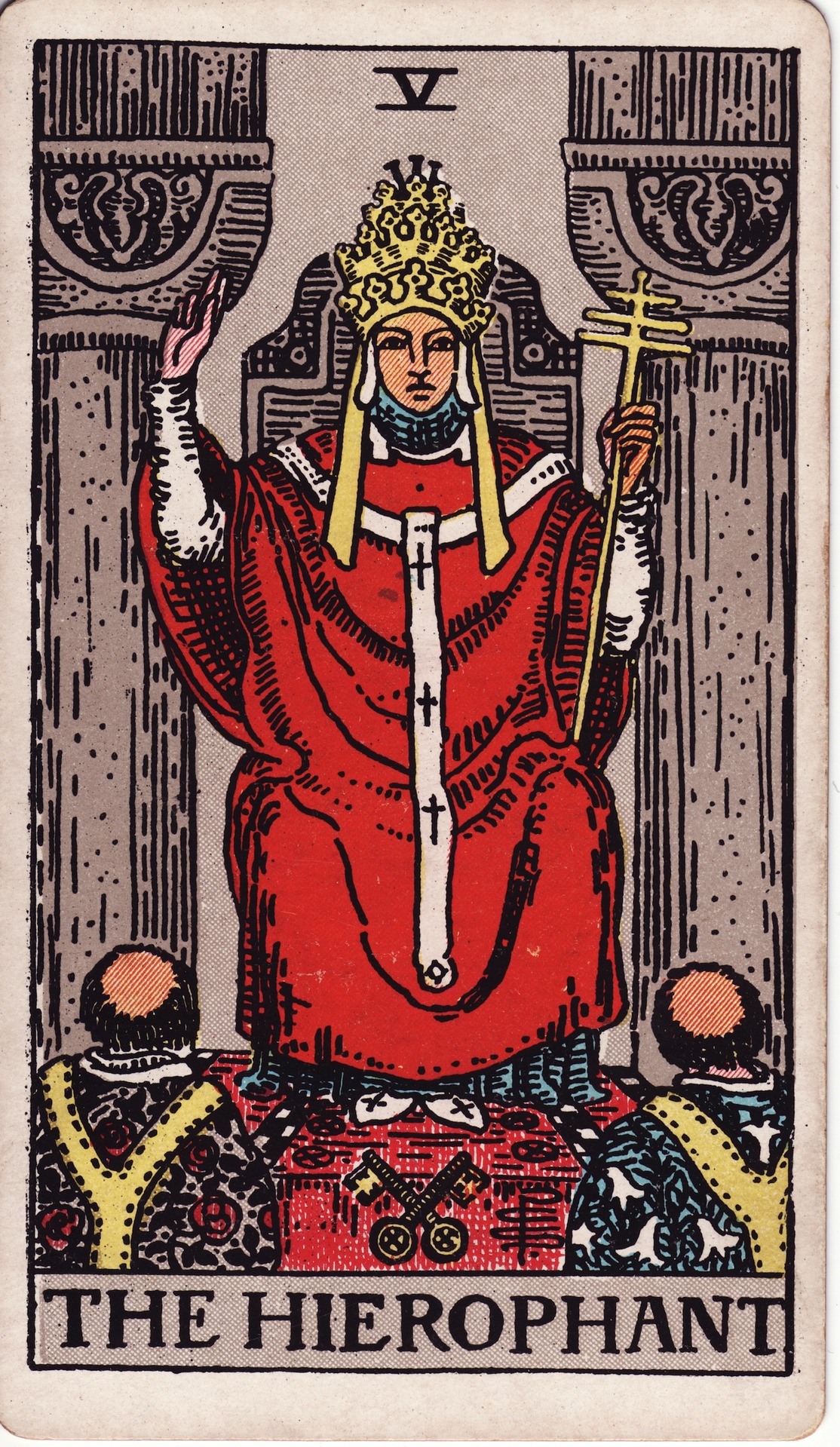
A religious figure sits enthroned between two gray stone pillars, in red vestments layered over blue and white. He wears a tall golden triple crown and holds a staff ending in a triple cross. His right hand is raised in blessing, two fingers lifted and two folded, a gesture some read as joining heaven to earth.1 Two crossed keys lie at his feet, and two tonsured clergymen kneel before him, one robe patterned with red roses, the other with white lilies.
In older decks this card was the Pope; some modern decks call him the Teacher.1 Waite broadened the meaning: the Hierophant is "the ruling power of external religion," set against the High Priestess, who guards what is hidden, and these are not her pillars.2 The triple crown and layered robes are often taken as three levels of mind he presides over, and the keys as waking and hidden awareness in balance, opening what would otherwise stay locked.1 The kneeling pair look like candidates received into an order, so the scene is also an initiation into a shared role.1 Astrologically the card is assigned to Taurus.1
Upright
The Hierophant is the card of tradition, institutions and shared belief. He represents the established way of doing things, the teaching handed down from one generation to the next, and the groups that hold it: churches, schools, professions, families. Waite's meanings include marriage, alliance, captivity and servitude, and by another account mercy, goodness and inspiration; he can also be the person to whom you turn for advice.2 He comes just before the Lovers, and the order matters: before you settle what you yourself believe, you first learn the established version from someone who knows it well.1
That often means a teacher, mentor or spiritual guide, sometimes stern and sometimes generous, or a stretch of formal study in a subject with a long written tradition behind it.1 Once your own field is mastered, the card may cast you as the teacher instead, with the duty of passing on what you know in an orderly way and with respect for where it came from.1
At work, the card favors conventional paths: following procedure, joining an established company, earning a credential, or learning from someone who knows the field. It is not the moment to break the mold; the card describes sticking with a proven method because it reliably gets results, and saving untested ideas for later.1 With money, it suggests sound, conservative choices and trusted advisers. In love, it is a traditional card of commitment, often linked to marriage and formal ceremony, and to relationships built on shared values and family approval. It can also describe a couple bound as much by expectation as by choice.
On a personal level, the Hierophant asks what you believe and where you learned it. Study, ritual, and membership in a community can give structure and meaning, and sometimes the best guidance is the accumulated wisdom of those who walked the path before you. If ritual has dropped out of your life, the card can be a nudge to take up a simple daily practice, revive a family custom that has lapsed, or look into the faith or heritage you come from, and to do it as handed down rather than reworked to taste.1 It also speaks to belonging: the ease of being among people whose values are stated plainly, whether that group is a congregation or something as ordinary as a gym or an online circle of fellow hobbyists.1
Reversed
Reversed, the Hierophant questions tradition. You may feel boxed in by rules, by a family's expectations, or by an institution that has stopped serving its purpose, and the card can mark the moment you decide to find your own way instead. At its best the reversal says the teacher you have been looking for is you: the answers come from inside rather than from an outside authority, and you no longer need anyone's sign-off to act.1 Going your own way can feel shaky at first, and others may doubt your reasons, but trust in your own judgment grows with use.1 At work, this can be a break from convention, a challenge to an outdated policy, or leaving a structured career for something less certain.
The reversal also asks you to look at the unwritten house rules you have been following on autopilot and test them against your own values; ideas you were taught as simply true may turn out to be one view among several.1 Pushed further, the questioning becomes open defiance: friction with a parent, a boss or the authorities, or involvement in causes set against institutions.1
The reversal has a darker side too: rigid dogma, empty ritual, hypocrisy, or authority that demands obedience without earning respect. Waite warned that a pontiff may forget the symbolic nature of his office.2 In relationships, it can point to an unconventional arrangement, to disagreement over values or religion, or to pressure to conform to what others think a partnership should look like.
Waite's reversed meanings are society, good understanding, concord, over-kindness and weakness.2 Here the problem is not too much rule but too little backbone: going along to keep the peace. The task is to keep what is genuinely valuable in tradition while refusing what you only accepted from habit.
Notes
- Biddy Tarot, "The Hierophant Tarot Card Meanings", https://www.biddytarot.com/tarot-card-meanings/major-arcana/hierophant/
- A. E. Waite, The Pictorial Key to the Tarot (1911), The Hierophant, https://sacred-texts.com/tarot/pkt/index.htm