The High Priestess (II)
Appearance
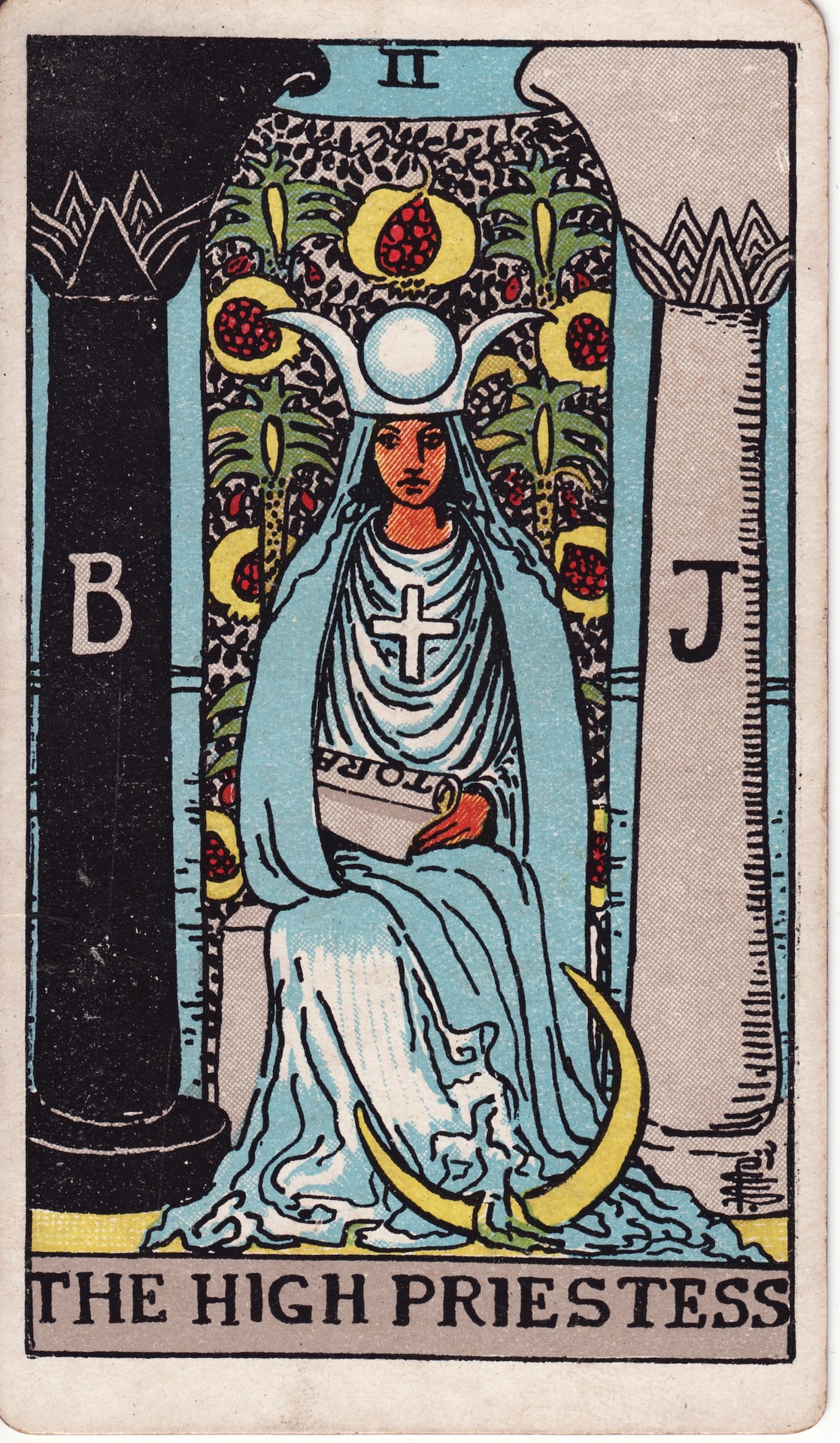
A woman sits on a stone seat between two pillars, a black one marked B on the left and a white one marked J on the right, both with lotus-shaped capitals. Behind her hangs a veil patterned with palm leaves and pomegranates, with a strip of water visible beyond it. She wears a blue mantle over a white gown, an equal-armed cross on her breast, and a horned crown holding a globe. A scroll marked TORA rests on her lap, partly hidden by her robe, and a crescent moon lies at her feet. Her calm face gives nothing away.
The pillars are Boaz and Jachin from Solomon's temple, names usually glossed as strength and establishment; their black and white suggest that to pass between them you must accept both halves of every pair.1 The veil divides seen from unseen and screens the sanctuary from idle eyes, and its pomegranates recall Persephone, bound to the underworld by the seeds she ate.1 Older decks called her the Papess, a female pope. Waite wrote that the half-covered scroll shows that "some things are implied and some spoken," and called this card in some respects the highest and holiest of the trumps.2
Upright
The High Priestess is the card of what is known but not yet said. Waite's meanings are secrets, mystery, the future as yet unrevealed, silence, tenacity and wisdom.2 Where the Magician works in the waking, tangible world, she keeps the deeper layer beneath it and crosses between the two without effort; things are rarely only what they appear, and more is at work than the surface shows.1 The card usually advises patience and attention to intuition: the answer exists, but it will come through quiet observation, a dream, a hunch, or a fact that surfaces in its own time, not through pushing. Reasoning a problem through will not crack it here. What helps is time spent quietly with it, and noticing where life has gone out of balance or stopped moving easily.1
In love, it can point to attraction that has not been spoken, a connection with a strong element of mystery, or someone who keeps part of themselves private. It may also signal that something is being withheld, and that you will learn more by watching than by asking directly. For someone single, it suggests looking inward before looking outward. At work, it favors research, study, discretion and confidentiality; it can mean information is still missing, so major decisions or financial commitments should wait until more is clear. In negotiations, keep your own counsel.
On the personal level she is the inner teacher. The veil behind her is not a wall but a threshold, and the card invites time alone, reflection, and trust in knowledge that does not arrive as argument. Meditation, visualization, and the company of others on a spiritual path all help here.1 For anyone developing intuitive or psychic skill, she is a sign to keep going, since that kind of sense sharpens the more it is used.1 She can also be a call to tend the receptive side of yourself, whatever your gender: sensing before analyzing, cooperating instead of competing, and treating empathy and care for others as strengths rather than something to hide.1
Reversed
Reversed, the High Priestess points to intuition ignored or drowned out. You may be listening to everyone's opinion except your own, or so busy that the quiet signal never gets through. The result is confusion and second-guessing, often about a situation in which you already sensed the truth. Sometimes the cause is not noise but distrust: a feeling that acting on a hunch is foolish or self-indulgent, or a habit of keeping your intuitive side out of sight because you expect others to judge it.1 The remedy is to step away from other people's dramas and treat that inner sense as a resource, a still place in you that outside events do not reach and that is there whenever you go quiet enough to hear it.1
Secrets are another theme. Hidden agendas, gossip, or information kept from you may come to light, or you may be the one keeping something back to your own cost. In relationships, this can mean distance, emotional withdrawal, or an atmosphere where things go unsaid for too long. At work, beware decisions made on partial information and colleagues who know more than they admit. If you suspect talk behind your back, a direct and honest conversation will do more good than quietly building a case or sliding into suspicion.1
Waite's reversed meanings move in a different direction: passion, moral or physical ardor, conceit, and surface knowledge.2 Here the stillness of the card is lost to heat and impulse, or to the confidence of someone who has read the summary and mistaken it for understanding. The advice is to slow down, step back from the noise, and go deeper before acting.
Notes
- Biddy Tarot, "The High Priestess Tarot Card Meanings", https://www.biddytarot.com/tarot-card-meanings/major-arcana/high-priestess/
- A. E. Waite, The Pictorial Key to the Tarot (1911), The High Priestess, https://sacred-texts.com/tarot/pkt/index.htm