Ace (1) of Swords
Appearance
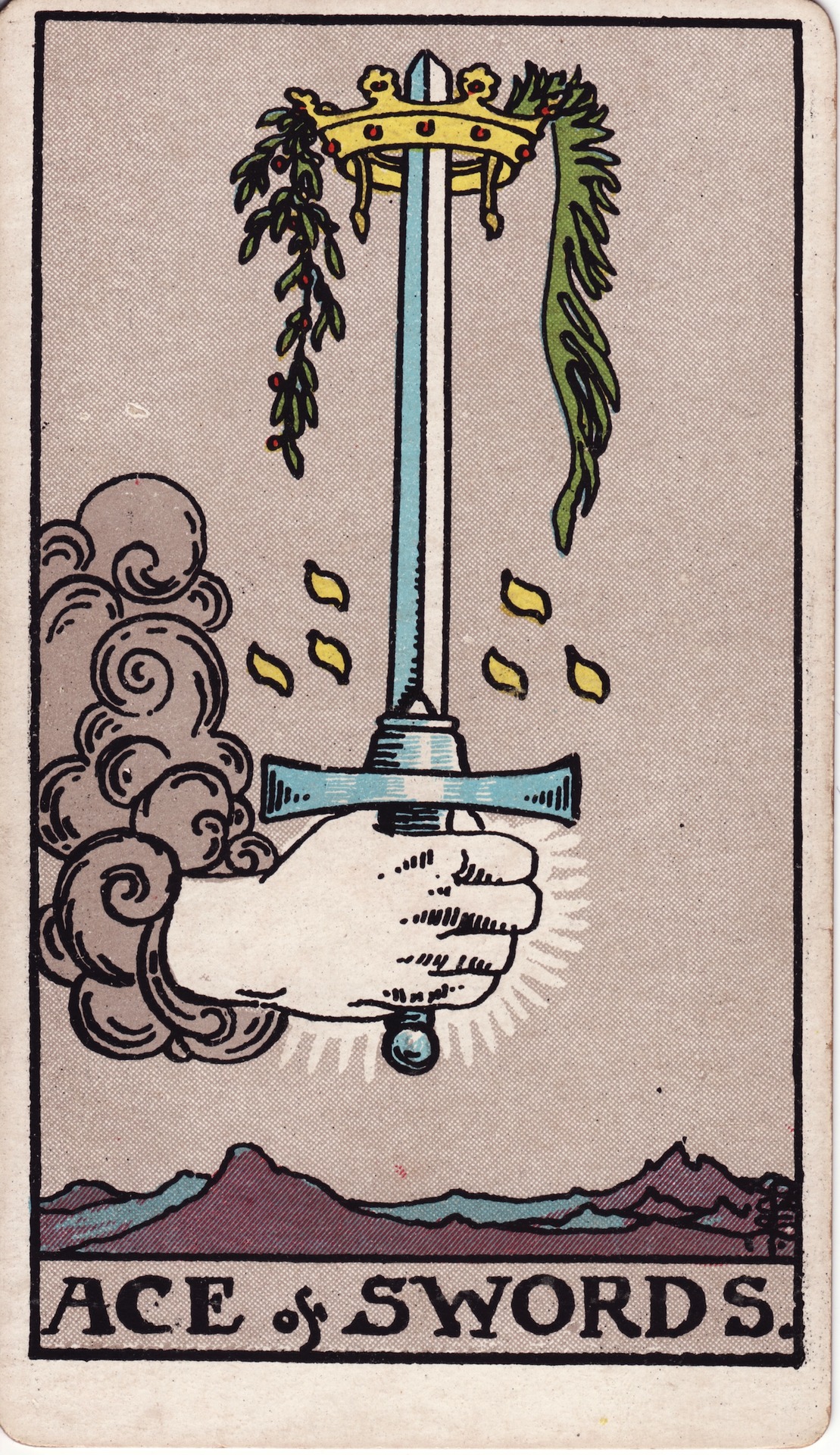
A white hand emerges from a gray cloud on the left of the card, gripping a double-edged sword by the hilt and holding it straight up. A faint glow radiates around the fist. At the tip of the blade sits a golden crown, and from it hang two sprays of greenery: an olive branch with small red berries on one side and a palm frond on the other. Six yellow drops, shaped like small flames or the Hebrew letter yod, fall through the air on either side of the blade. Far below, a range of bare purple and blue mountains runs along the bottom of the card.
Swords belong to air: the mind, speech, judgment, and conflict. As the ace, this card is the suit's raw force in a single stroke. Waite read it as triumph and conquest, and noted that the crown may carry a much higher meaning than ordinary fortune-telling usually reaches.1 The hand from the cloud reads as a gift from above, here the gift of a clear mind. The mountains matter too: victory waits at the tip of the blade, but the ground below is steep and broken, and crossing it takes real stamina of mind.2
Upright
The Ace of Swords is a breakthrough of clarity. A fog lifts, a decision becomes obvious, the truth of a situation is suddenly impossible to ignore. As the first card of the suit, it brings new ideas, sharp insight, and the will to act on them. Often it shows up as an appetite: the mind wants to stretch, to learn, to take on something harder than usual.2 Waite's meanings are triumph, conquest, and "the excessive degree in everything," and he called it a card of great force, in love as well as in hatred.1 The blade cuts both ways; it clears a path, but it does not soften what it reveals.
That double edge is also a question of use. The same clarity that can build a case can tear a person down, and the ace leaves the choice with you: whether the new power serves something larger than winning, or only your own advantage.2 It is a card for taking up a cause, standing up for yourself or for someone who cannot, and arguing for what is true once you finally see it plainly.2
In love, it asks for honest conversation. Something may need to be said plainly, a misunderstanding cleared up, or a relationship seen for what it really is rather than what you hoped it would be. At work, it favors fresh ideas, a strong argument, a successful pitch, an exam or interview where clear thinking carries the day, and legal matters decided in your favor. It is a good time to start something that runs on words and thought: a writing project, a course, learning to speak in front of a room.2 With money, it supports a decision based on the numbers rather than on wishful thinking.
On the personal level, the ace is mental focus and resolve: the moment you see your situation clearly and choose. A quiet mind holds that focus better than a busy one, so some regular practice of clearing the noise helps.2 Being an ace, it is a start, not an arrival, and the obstacles in those mountains are still ahead.2 The cost of the clarity is that some comfortable illusions will not survive it.
Reversed
Reversed, the force of the ace either fails to arrive or arrives without control. Clarity gives way to confusion: thoughts circle without landing, information is missing or wrong, and decisions get made on a misreading. The fix there is to go looking for the facts rather than accepting the first version you are told.2 You may have a good idea but no way to express it, or you may be pressing a point long after it stopped being useful. In conversations and relationships this can look like harsh words, arguments that wound more than they resolve, or the truth used as a weapon.
A gentler reading turns the sword inward. The idea is real but still forming, and you are not ready to show it to anyone; it needs private time before it can be said well, and that is not a failure.2 At other times the plan has simply not worked, or you are still chasing one that stopped mattering to you, or you have too many going at once to commit to any. Then the work is to start over and state, in concrete and measurable terms, what you are actually after.2
Waite gives the reversed card as the same as the upright, but with disastrous results.1 Read that as force applied in the wrong place or to excess. At work, watch for plans that collapse under scrutiny, miscommunication, or a dispute that escalates. With money, avoid decisions made in haste or anger.
He also records another account that reads the reversal as conception, childbirth, augmentation, and multiplicity, a distinct tradition in which the card signals growth rather than collapse.1 On the inner level, the advice is to slow down: gather the facts, cool the temper, and wait for the cloud to clear before you swing.
Notes
- A. E. Waite, The Pictorial Key to the Tarot (1911), Ace of Swords, https://sacred-texts.com/tarot/pkt/index.htm
- Biddy Tarot, "Ace of Swords Tarot Card Meanings", https://www.biddytarot.com/tarot-card-meanings/minor-arcana/suit-of-swords/ace-of-swords/