Two (2) of Swords
Appearance
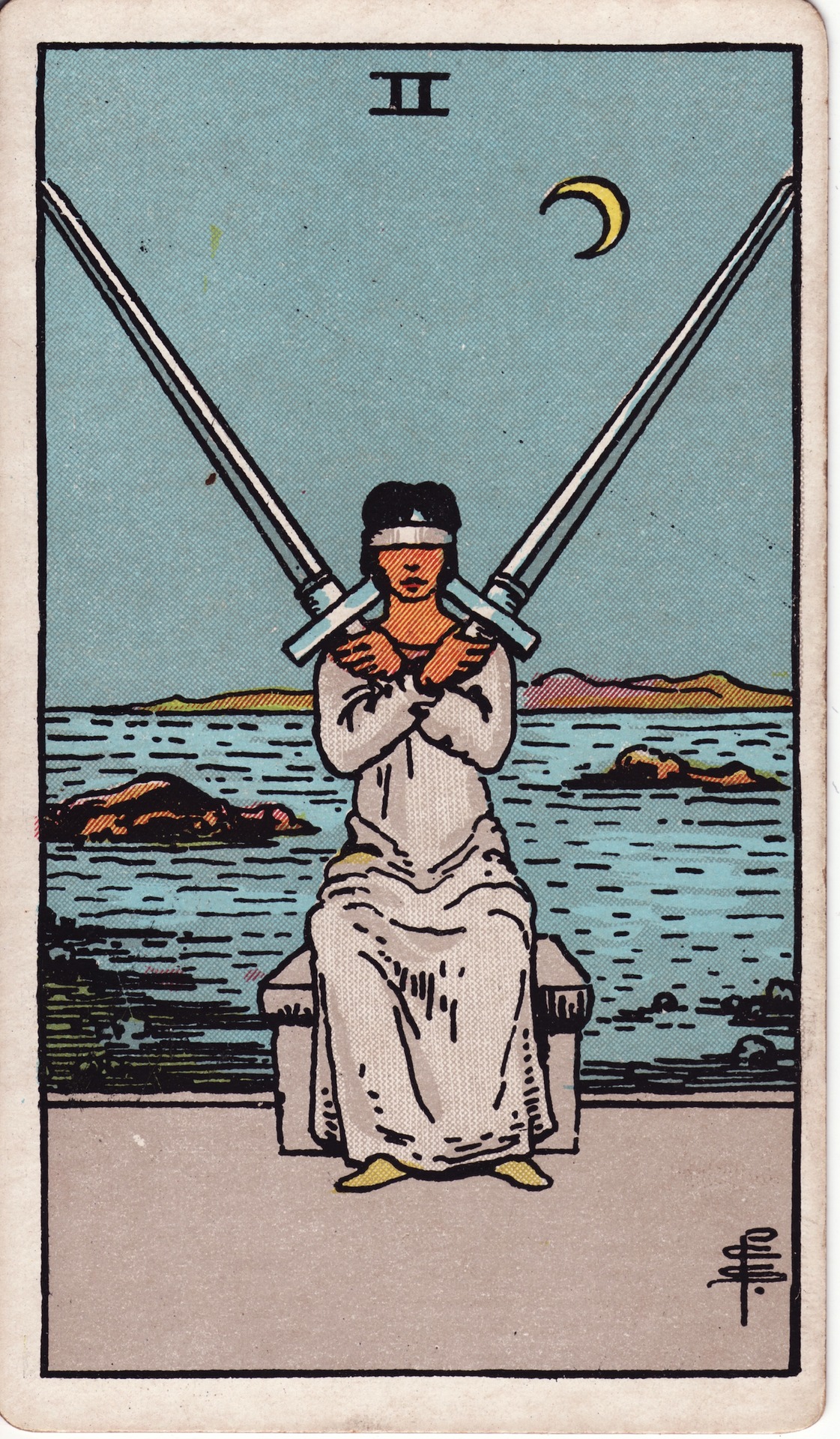
A woman in a long white robe sits on a stone bench with her back to the sea. She is blindfolded, and her arms are crossed over her chest, each hand holding a long sword that rises over the opposite shoulder, so the two blades spread out above her in a wide V. Behind her the water is dotted with rocks, and a far shore runs along the horizon. A thin crescent moon hangs in the upper right of a pale evening sky. She sits very still and very straight, as though any movement would upset the balance of the swords.
Two is the number of pairs and opposites. Waite read the card, with caution, as balance and concord "in a state of arms," and warned that its favorable readings must be qualified, since swords are seldom beneficent forces in human affairs.1 The sea at her back stands for feeling, which the suit of Swords usually lacks, so this is a choice that reasoning alone will not settle.2 The rocks are the snags that make it harder than it looks, and the moon hints that she has an inner sense to steer by even with her eyes covered.2
Upright
The Two of Swords is a standoff. Two choices, two loyalties, or two arguments are held in perfect tension, and the price of keeping them balanced is that nothing moves. The blindfold matters: the woman has chosen not to look, either because she lacks information or because looking would force a decision she is not ready to make. In the first case the remedy is homework: dig into the options, ask people whose judgment you trust, and look for the hidden risk or the third path nobody has mentioned.2 In the second, the blindfold is a way of hoping the problem will dissolve if left alone, and it rarely does; each week of waiting just lengthens the standoff.2 Waite's meanings include conformity, courage, friendship, and concord, but this is the peace of a truce rather than of a resolution.1
In love, it can mean being caught between two people, or a couple who avoid a difficult conversation to keep things calm. It can also describe guardedness: arms crossed over the heart, letting no one close. At work, it points to a stalemate between colleagues, a decision postponed, or being asked to choose sides. With money, two options may look equally good or equally bad, and delay is itself a choice with costs.
Inwardly, the card shows the effort of holding emotion at arm's length so the mind can stay level. That can be wise for a while, but the choice in front of her usually needs both the reasoning of the swords and the feeling of the sea behind her.2 Hard decisions seldom come with a clean answer, and the card does not promise one. The way through is to lower the blindfold, gather what you need to know, accept that either path will cost something, and then commit knowingly.2 As a practical aid, some readers lay one card on each side of the Two to name the options being weighed, or deal a pair for each option to set its gains against its drawbacks.2
Reversed
Reversed, the balance gives way. The decision that was held off may be forced by events, or the strain of holding two options apart may become too much, leaving you anxious and overloaded with information that points in every direction. When everyone has an opinion, the work is to keep the few that bear on your case and let the rest go.2 Sometimes this is a relief: the stalemate breaks and you finally see clearly enough to choose. Sometimes it is simply indecision turned into paralysis, especially when both paths look like losses and standing still only makes matters worse.2
A less common reading puts the blindfold to good use. If outside voices are the trouble, it can help to shut them out for a while on purpose, so your own sense of what is right has room to speak, and then to decide by that.2
In relationships, feelings that were suppressed to keep the peace may surface all at once, or a third party may come into the open. At work, a truce between colleagues may end, or a long-postponed choice may come due with less room to maneuver. The card can also show a deadlock in which every side, whether partner, friend, coworker, or supplier, refuses to see it the other way; nothing moves until someone tries a new angle and finds ground for compromise.2 Another version puts you in the middle, carrying complaints between two relatives who will not speak to each other and absorbing tension that is not yours. Ask honestly whether you can bring them together; if not, step out.2
Waite's reversed meanings are imposture, falsehood, duplicity, and disloyalty, and his additional notes give dealings with rogues.1 In this reading the danger is not your own blindfold but someone else's deceit: a person who has been playing both sides, or an agreement that was never what it seemed. Ask who benefits from keeping you uncertain, and look at the facts before you trust the calm.
Notes
- A. E. Waite, The Pictorial Key to the Tarot (1911), Two of Swords, https://sacred-texts.com/tarot/pkt/index.htm
- Biddy Tarot, "Two of Swords Tarot Card Meanings", https://www.biddytarot.com/tarot-card-meanings/minor-arcana/suit-of-swords/two-of-swords/