Death (XIII)
Appearance
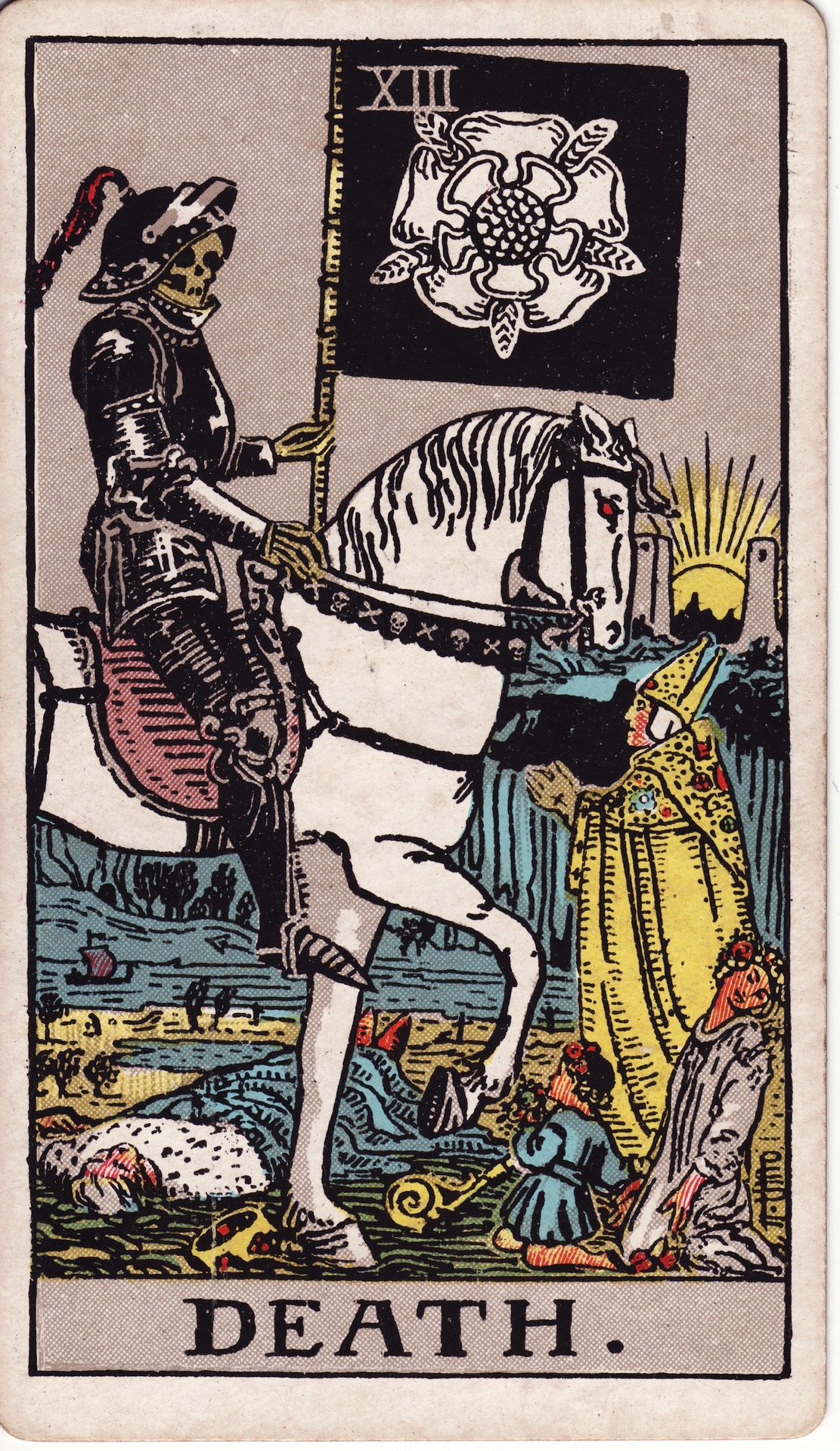
A skeleton in black armor rides a white horse at a walk, carrying a black banner marked with a large white rose. A red plume rises from his helmet. A dead king lies before the horse, his crown fallen beside him. A bishop in a yellow robe and miter stands facing the rider with his hands pressed together, while a young woman kneels with her head turned away and a small child looks up, holding out flowers. Behind them a river runs past with a boat on it, and in the distance the sun rises between two towers.
Waite replaced the older reaping skeleton with this apocalyptic horseman, who carries no weapon. In his reading the rose signifies life, the sun between the pillars is the sun of immortality, and the card's real subject is change, transformation and passage from lower to higher.1 The armor means nothing turns him aside, and the four figures show that no one is exempt. The rose has five petals, five being the number of change; the boat recalls the mythic ferries of the dead; and the towers reappear in the Moon card, with a sun between them that dies and returns daily.2
Upright
Death almost never means physical death. It is the most feared card in the deck and one of the most hopeful, because it is the card of endings that clear the way for something new: a chapter closing, a role or identity that has run its course, a situation that cannot continue in its present form.2 Waite's list begins bluntly with end and mortality, but he wrote that the better explanations of the card are rebirth, creation and renewal, and that is how it is read in practice.1 In the sequence of the Major Arcana it follows the Hanged Man, so the long suspended pause gives way to an actual ending once you see that something no longer serves you.2
In love, it may mark the end of a relationship, or the end of one stage of a relationship so that another can begin: the first excitement giving way to something deeper, a couple moving in together, a marriage changing after children. For someone single, it can mean finally letting go of a past partner. At work, it points to a job ending, a restructuring, a career change, or the close of a long project. With money, it can mean changing how you earn, or giving up a pattern of spending that no longer fits.
Sometimes the change is not chosen. Just as the rider passes over kings and children alike, the card can describe being swept up in an upheaval you cannot step out of, especially when the Tower or the Hanged Man lies nearby. Painful as that is, such disruptions often turn up openings and advantages nobody planned for.2
The horseman moves slowly and does not argue; resistance only makes the passage harder, and the strain of holding on can show in the body as well as the heart. What helps is picturing what could take the old thing's place, so that better habits have somewhere to grow.2 On a personal level, Death invites you to release what is already finished, grieve it if you need to, and make room for the version of yourself that comes next. It is a good card for breaking a bad habit, trimming what is excessive, and clearing out possessions, old grudges and memories that only weigh you down.2
Reversed
Reversed, Death usually points to resisting an ending that is already underway. You may be holding onto a relationship, job or habit long after it has stopped working, because the unknown seems worse than the familiar, or you may sense the change is needed and simply not know how to begin it. Old beliefs carried over from the past can quietly spoil a new chance.2 Waite's reversed meanings capture this stuck quality precisely: inertia, sleep, lethargy, petrifaction.1 Nothing ends, but nothing new can begin either.
In relationships, this can look like staying together out of fear rather than love, or reopening a door that should stay closed. At work, it may mean clinging to a role with no future, or refusing to adapt to changes that have already happened around you. Money can stagnate for the same reason: old patterns repeated because changing them feels like loss. The way out is usually a deliberate shift of attitude, consenting to the change instead of bracing against it, and a short spoken affirmation of that consent can be enough to loosen things.2
The reversal can also indicate a transformation happening slowly and privately, an inner change still in progress before it shows outwardly. That may mean shedding fears and self-limiting beliefs, remaking daily habits, or a deliberate physical or spiritual cleanse. A further card drawn for the question can show what exactly is being purged, and there is no need to announce the process; tell the story once it is complete, when it can encourage someone else.2 Either way, the card asks what you are keeping alive past its time. Letting it go will hurt, but the longer an ending is delayed, the more it costs. Waite's last reversed phrase, hope destroyed, describes where that delay tends to lead.1
Notes
- A. E. Waite, The Pictorial Key to the Tarot (1911), Death, https://sacred-texts.com/tarot/pkt/index.htm
- Biddy Tarot, "Death Tarot Card Meanings", https://biddytarot.com/tarot-card-meanings/major-arcana/death/