The Hanged Man (XII)
Appearance
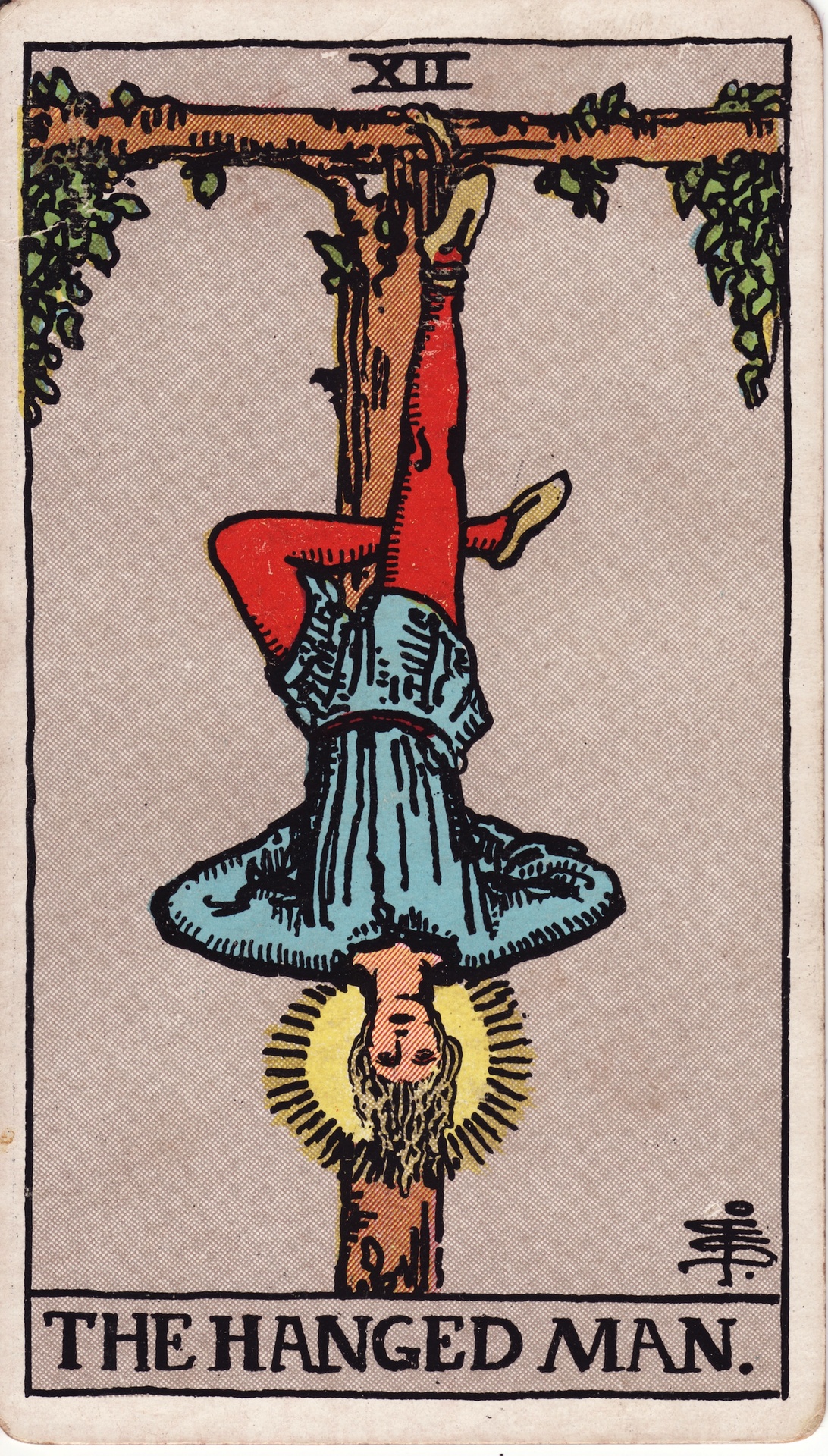
A man hangs upside down from a T-shaped frame of living wood, its beams still sprouting leaves. A rope ties one ankle to the crossbar; his other leg is bent behind the straight one so that the two form a rough cross, and his arms are folded behind his back, out of sight. He wears red hose and a blue tunic belted at the waist. His face is calm, almost serene, and a bright yellow halo surrounds his head, which hangs just above the foot of the trunk. The background is plain gray.
Waite insisted that the face shows "deep entrancement, not suffering," and that the figure suggests life in suspension, not death.1 He dismissed most published interpretations of the card as vanity and said only that it expresses one aspect of the relation between the Divine and the universe.1 Later readers build on that calm: nothing in the picture shows a struggle, so the man seems to be there by choice, and the halo marks the clarity that comes from staying put.2 The folded arms and the lowered head make a triangle pointing down, and red is often read as the body and its appetites, blue as understanding.2
Upright
The Hanged Man stands for a willing pause. Something is suspended, a plan, a decision, a relationship, a career move, and forcing it forward will not help; pushing harder tends only to multiply the obstacles.2 The card suggests that the delay can be useful if you let it change how you see things. Turning the world upside down is uncomfortable, but it shows you what you could not see standing up. Often what has to go is a habit of thought: the methods and assumptions that carried you this far are not the ones that will carry you further.2 Waite's divinatory meanings include wisdom, circumspection, discernment, trials, sacrifice and intuition.1
A pause can be chosen or imposed. If you notice early that things need to stop, you can step back on your own terms; if you ignore the signs, the stop tends to come anyway, as setbacks that keep piling up, a project that collapses, or a body that finally gets sick.2 Better to take the hint while it is still quiet.
In love, it can describe a relationship in limbo, waiting on one person's decision, or a period of reflection in which you see your partner, or yourself, from a different angle. It may ask you to give something up, such as the need to be right or a fixed picture of how things should go, so that something better can take its place. At work, it points to stalled projects, waiting on approvals, or a sideways step that looks like a setback but gives you room to rethink. With money, hold off on major moves until the situation clarifies.
Inwardly, this is a card of surrender in the sense of releasing control rather than giving up. The calm on the hanging man's face is the point: he has accepted where he is, and that acceptance is what lets insight arrive. If you feel stuck, ask what exactly is holding you in place, and consider stepping out of your usual routine for a while, a long walk outdoors, a few days away, or a bigger change of scene, since a new setting loosens old ways of seeing.2 The card also carries an older note of sacrifice for something larger than yourself: giving up a personal advantage for the sake of other people or a cause.2
Reversed
Reversed, the pause turns into stalling or resistance. You may be stuck and refusing to see the situation differently, waiting for something to change while doing nothing to change it. Delays drag on, decisions are postponed indefinitely, and time that could have gone to reflection is spent in frustration. Sometimes the hold is not yours at all: other people or outside events have left you waiting, and the work is to stop fighting that fact and loosen your grip on how it was supposed to go.2 In relationships this can look like an endless holding pattern, or staying because leaving would mean admitting something. A gentler version is a relationship you are willing to give time, because it is complicated and cannot be hurried, while knowing that at some point you will have to choose.2
It can also mean the opposite: an unwillingness to pause at all. Here the reversed Hanged Man rushes into action to avoid sitting with discomfort, or makes sacrifices that were never needed and then resents them. A full calendar becomes a way not to look at the real problem; the body is tired and asking to stop while the mind keeps running, and if that goes on long enough the stop arrives as burnout.2 At work, it may describe pushing on with a plan that clearly needs rethinking, or martyrdom: taking on too much and expecting gratitude. Another form of stalling is waiting to feel completely ready before acting; that feeling rarely comes, and the decision has to be made without it.2
Not every reversal is bad news. After a long stretch on hold, it can mean the suspension is ending: the insight has landed, you know what to do differently, and things begin to move again with less friction.2
Waite's reversed meanings are unusual: selfishness, the crowd, the body politic.1 They suggest a person absorbed in self-interest or swept along by group opinion instead of their own judgment. The card asks you to step back from the noise, decide what you are actually willing to release, and let it go without keeping score.
Notes
- A. E. Waite, The Pictorial Key to the Tarot (1911), The Hanged Man, https://sacred-texts.com/tarot/pkt/index.htm
- Biddy Tarot, "The Hanged Man Tarot Card Meanings", https://www.biddytarot.com/tarot-card-meanings/major-arcana/hanged-man/