Five (5) of Cups
Appearance
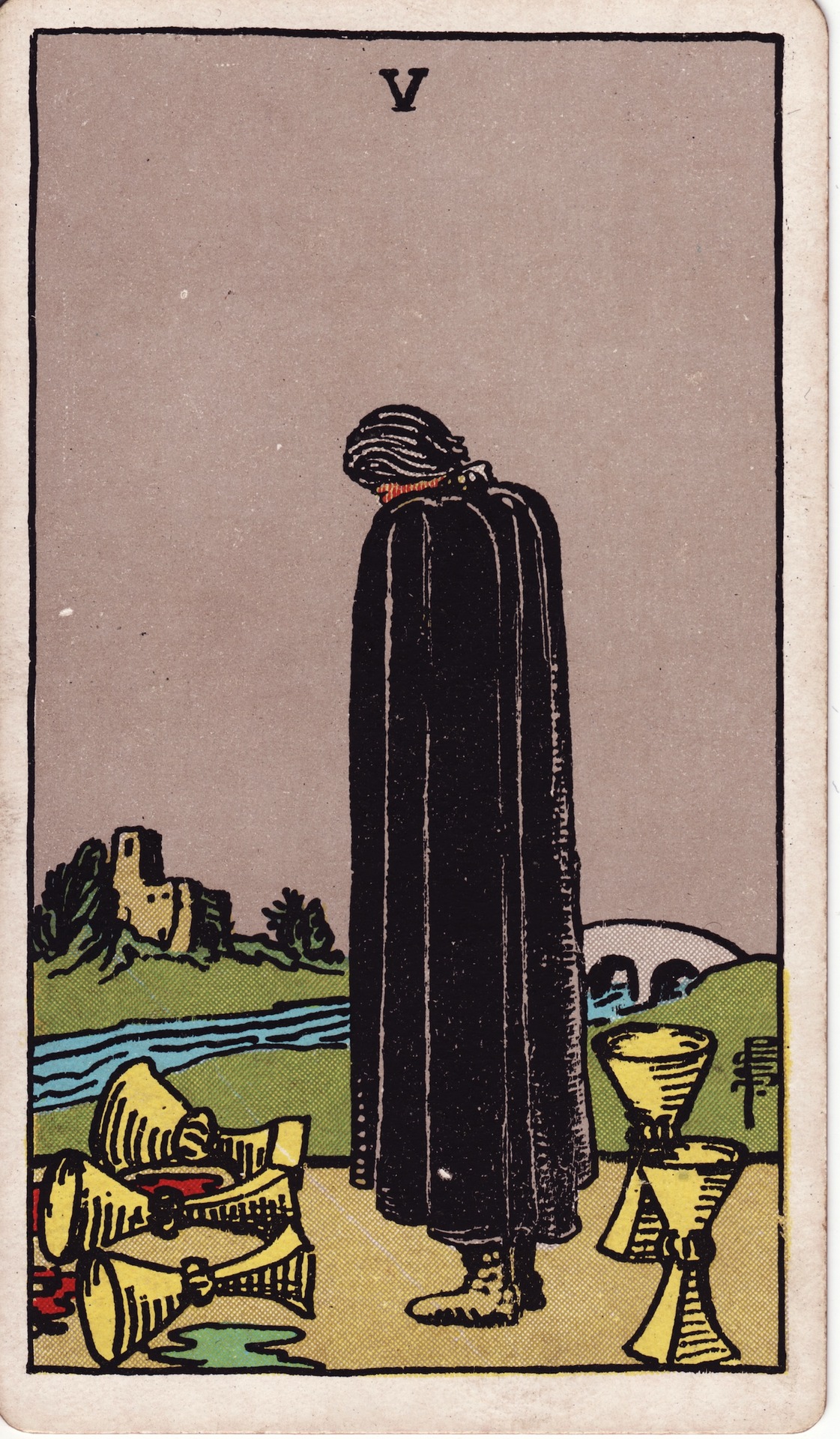
A tall figure in a long black cloak stands with head bowed, looking down at three cups that have toppled over on the ground, their contents spilling out in red and green. Behind the figure, out of its line of sight, two more cups still stand upright. A river runs across the background. On the far bank, to one side, a small keep stands partly ruined among trees; on the other, a stone bridge arches over the water. The sky is a flat, colorless gray.
Five in the minor arcana is the number of disruption, the point where the stability of four is shaken. In the suit of feeling this means loss and grief. Waite put the card's lesson plainly: "it is a card of loss, but something remains over; three have been taken, but two are left."1 The two standing cups are the chances still open, and the figure misses them only because his eyes are on the spill.2 The bridge and the keep say the same thing: there is shelter on the far bank, and a crossing to reach it, for anyone willing to step away from the fallen cups and look for the way over.2
Upright
The Five of Cups is the card of grief, regret, and disappointment. Something has been lost or has gone wrong, and all the attention is fixed on what spilled. Waite's reading is careful to include both halves of the picture: the loss is real, but it is not total.1 Three cups have fallen; two are still standing, unnoticed behind the mourner's back.
The card often describes being stuck. Old hurts get replayed, and the story told about them tends to slide toward one of two poles: it was all my fault, or life simply did this to me. Either version keeps a person bent over the same three cups, and the energy spent there is not available for anything else.2
In love, it can describe a breakup, an estrangement, or the sadness of realizing a relationship is not what you hoped. It can also be regret over a past choice, replaying what you should have said or done. At work, it points to a setback: a failed project, a missed promotion, a deal that fell through. With money, it can mean a loss or a disappointing legacy; Waite lists inheritance and patrimony "not corresponding to expectations," and adds that some read it as a marriage "not without bitterness or frustration."1
The card does not ask you to skip the mourning. Grief needs its time, and the cloaked figure is entitled to it. A workable compromise is to give the sadness a set window, feel it fully, and then decide to stand up when the window closes.2 Forgiveness is often what makes that possible, both toward whoever let you down and toward yourself, since you acted on what you knew then. Looking back with clearer eyes, ask what led here and what you would do differently; the lesson is one of the cups still standing.2 The card also points, quietly, toward what remains: the friendships, resources and possibilities still within reach. When you are ready, turn around. The bridge in the background is a way across.
Reversed
Reversed, the Five of Cups is often the turn toward acceptance. The mourner is beginning to look up, to notice the two cups that remain, and to forgive themselves or someone else. You may be moving on from a breakup, making peace with a professional failure, or finding that a loss has left room for something better. With some distance, the painful episode starts to make sense as part of a larger story, and the heart becomes willing to take risks again.2
A quieter form of the reversal is the setback kept private. Shame at having failed, or at having picked the wrong road, can make a person hide how much it hurts, and the people nearby may have no idea. Here the card suggests telling someone you trust; the weight usually drops once it is shared, and the setback begins to look temporary.2 Where guilt is the main trouble, the card leans toward self-forgiveness. One suggestion is the Hawaiian practice of ho'oponopono, which moves through apology, a request for forgiveness, thanks, and finally love.2
Waite's reversed meanings are unusual and specific: news, alliances, affinity, consanguinity (blood relationship), ancestry, return, and false projects.1 Together they suggest the reappearance of family, the return of someone long absent, or old ties renewed. His later notes add the return of a relative who has not been seen for a long time.1
The reversal can also mean the opposite of healing: grief that has been pushed down rather than worked through, or a refusal to let go that keeps the spilled cups at the center of life. In that form it shows someone stuck in regret, unable to move toward anything new. If that sounds familiar, the advice is not to hurry but to begin, even slowly, to turn around.
Notes
- A. E. Waite, The Pictorial Key to the Tarot (1911), Five of Cups, https://sacred-texts.com/tarot/pkt/index.htm
- Biddy Tarot, "Five of Cups Tarot Card Meanings", https://www.biddytarot.com/tarot-card-meanings/minor-arcana/suit-of-cups/five-of-cups/