Six (6) of Cups
Appearance
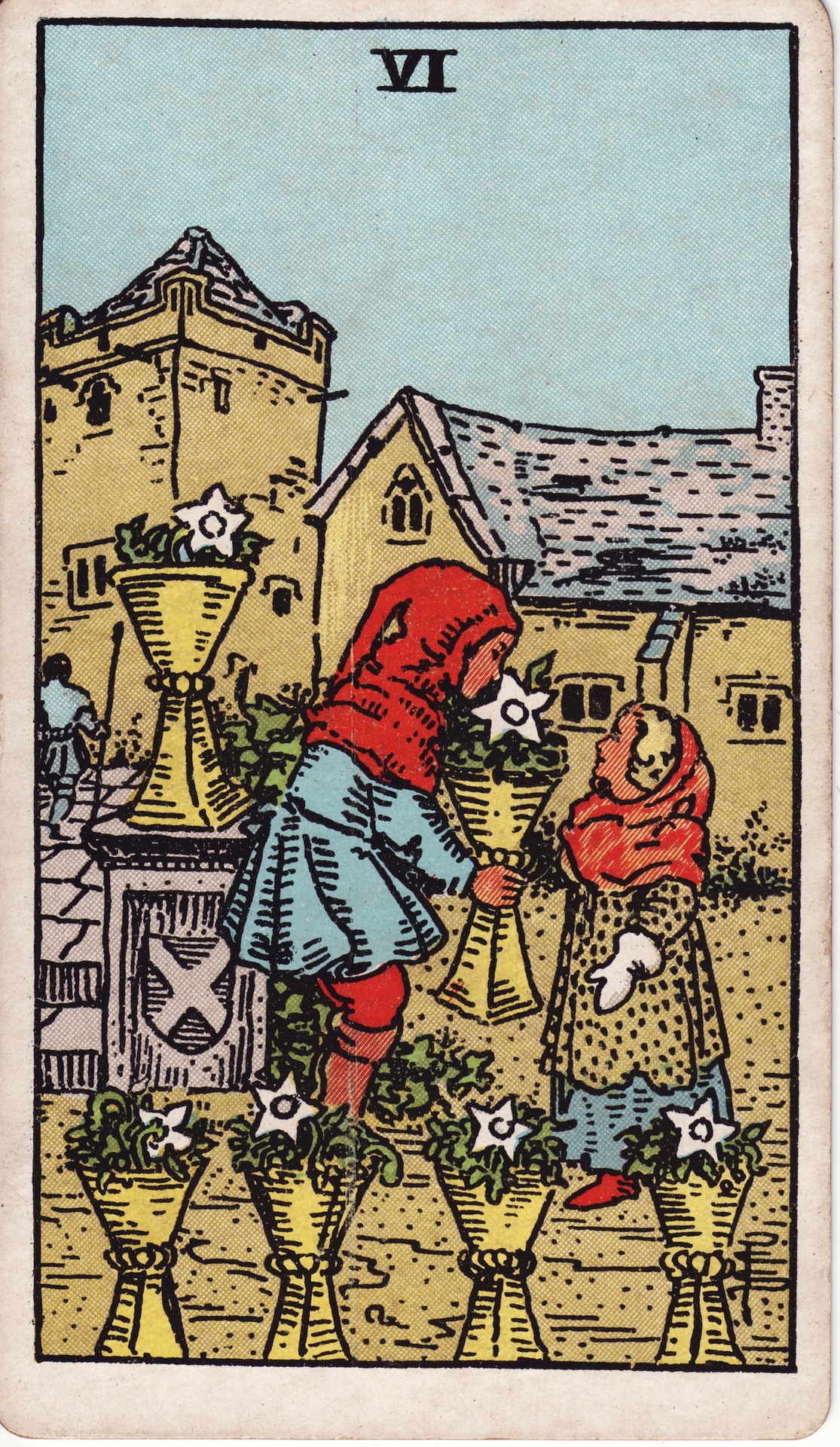
In the courtyard of an old village, a boy in a red hood and blue tunic bends toward a smaller girl and offers her a golden cup filled with leaves and white star-shaped flowers. She wears a red headscarf and a single white glove, and she turns her face up to him with trust and affection. Four more cups with the same flowers stand in a row in the foreground, and a sixth sits on a stone pedestal carved with a shield bearing a saltire cross. Behind them rise a square stone tower and a house with a slate roof, and at the far left a figure carrying a staff or spear walks away down the steps.
Six is the number of harmony, and here it is the harmony of the past. Waite summed up the scene as "children in an old garden" and made it the card of memories.1 The walled yard of a substantial house reads as shelter, a place where the children are safe, and the grown figure leaving the scene can be taken as adult worries stepping out of the frame for a while so that the young ones can simply play.2
Upright
The Six of Cups is the card of nostalgia, memory, and innocent kindness. It looks back toward childhood, old places, and earlier versions of yourself, usually with warmth. Waite described it as a card of the past and of memories, of "happiness, enjoyment, but coming rather from the past," and of things that have vanished.1
In practice it can mean a reunion with old friends, a visit to the place you grew up, or contact from someone in your past. In love, a former partner or a childhood sweetheart may reappear, or a current relationship may draw on shared history and familiar comfort. When an old connection returns, the card suggests enjoying the reminiscing and then asking honestly whether the two of you still fit as the people you are now.2 The card also favors simple affection: gifts given without calculation, play, tenderness, care for children. Coming after the grief of the Five of Cups, it often marks a softer season in relationships, when people cooperate, give without keeping score, and are willing to assume the best of each other again.2
Children may be literal here. The card can point to a pregnancy or birth, sometimes read as twins, to brothers and sisters getting along, or to more time spent with young kids, who often turn out to be the teachers: they model curiosity, openness, and being fully where they are.2
At work, it can point to returning to an old employer or field, or to work involving children, teaching, or care. With money, it is a card of small, generous gifts rather than large sums. Waite's later notes give it simply as "pleasant memories," but he also recorded an opposite reading: new relations, new knowledge, a new environment, with the children playing in an unfamiliar place.1
On a personal level the Six of Cups asks you to look at what your past still has to give you, the qualities you had as a child that are worth recovering, without mistaking the past for the present. Letting yourself play, make things, or act on a whim is not idle here; it is a way back to the self you were before roles took over, and to the intuition that came with it.2
Reversed
Reversed, the Six of Cups turns from the past toward what is coming. Waite's reversed meaning is "the future, renewal, that which will come to pass presently," and his later notes add an inheritance arriving quickly.1 This is the card of leaving the old neighborhood: stepping out of habits formed in childhood, outgrowing family roles, or simply being ready to move forward after a long period of looking back.
It can also show nostalgia gone wrong. Clinging to the way things used to be, idealizing an old relationship until no one in the present can compete, or resisting change at work because the old system felt safer are all forms of the blocked card. In love, it may mean trying to revive something with an ex that is better left in memory. Sometimes the looking back is kept quiet: thinking about an old flame, or even seeing them again, and telling no one because you expect to be judged for it.2 Some readers also link the reversal to painful childhood memories surfacing, which can be the start of healing if met with care. Forgiveness is the key to that work, of the people involved and of your own younger self, so that the past becomes something learned from rather than lived in.2
The opposite trouble is a life with no play left in it. Responsibilities pile up, days repeat, and everything feels flat; the reversed card can mean the child in you has been shut out so long that you no longer notice openings when they come. The cure is unglamorous and literal: make room for fun on purpose.2
At work and with money, the reversal favors independence over leaning on old networks, and plans based on present conditions rather than on how things once were. Honor the past, take what was good from it, and then let the present have its turn.
Notes
- A. E. Waite, The Pictorial Key to the Tarot (1911), Six of Cups, https://sacred-texts.com/tarot/pkt/index.htm
- Biddy Tarot, "Six of Cups Tarot Card Meanings", https://www.biddytarot.com/tarot-card-meanings/minor-arcana/suit-of-cups/six-of-cups/