Five (5) of Swords
Appearance
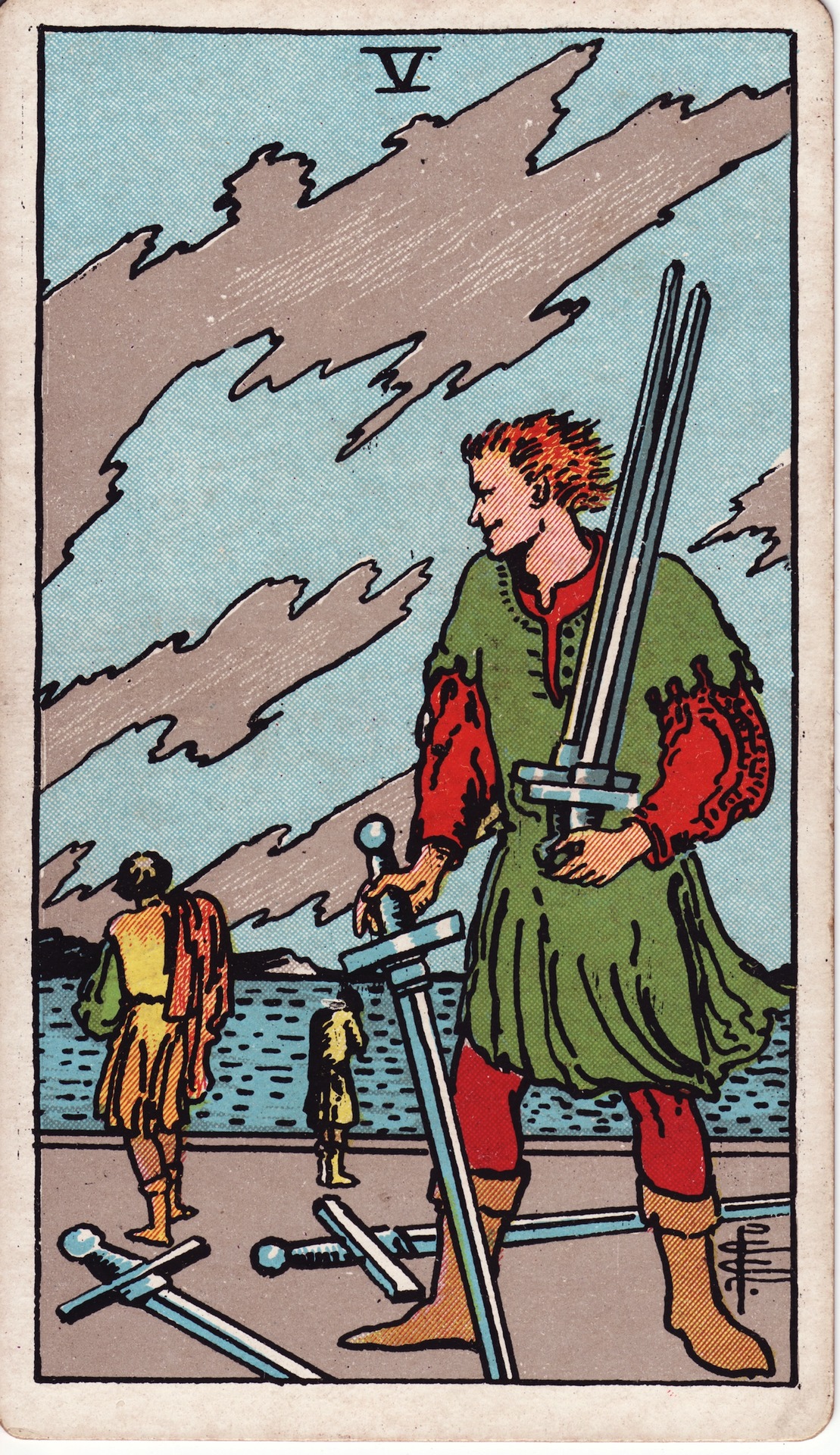
A young man with red hair stands in the foreground with a satisfied, faintly mocking look, glancing back over his shoulder. He holds two swords upright against his left shoulder and rests his right hand on a third, its point on the ground. Two more swords lie at his feet. Behind him, two figures walk away toward the water with their backs turned; the smaller one, farther off, appears to be bowed with a hand raised to the face. The sky is streaked with ragged, wind-torn clouds, and the sea beyond is choppy.
In Waite's words, the victor is "the master in possession of the field."1 Five is a number of disruption and strife throughout the minor arcana, and in the suit of swords the conflict leaves a winner who has gained little worth having. The torn sky makes the same point from another angle: the fighting is over, but the air has not cleared, and nothing about the scene feels settled.2
Upright
The Five of Swords is the card of a hollow victory. A conflict has been decided, but the way it was won leaves no one better off. Someone has taken the field and the weapons, and everyone else has walked away humiliated or beaten. Waite's meanings are severe: degradation, destruction, revocation, infamy, dishonor, and loss, and his additional notes give an attack on the fortune of the querent.1
Often the card turns up just after the falling-out, when words spoken in anger still hang in the air and you would take some of them back if you could.2 Winning does not help much. The person who carried the argument may find that it cost them trust, standing, or plain dignity, and that friends and colleagues now keep a careful distance.2 The real question becomes whether being right matters more than the people involved.
In love, it can point to an argument that one person wins at the cost of the relationship, cruelty disguised as honesty, or a breakup with bitterness on both sides. At work, it shows office politics, a rival who undermines you, a competition won through tactics you would rather not look at, or a team divided after a fight. It can also describe your own stance: treating peers as threats to your success and grabbing every advantage, whatever it does to the people around you.2 With money, it warns of loss through conflict, a dispute that costs more than it recovers, or being taken advantage of.
The card asks which figure you are. If you are the one walking away, it may be time to accept that the fight is not worth continuing. Sometimes that is literal: despite real effort, you lose. The danger then is letting the loss sour into a bitterness that does more harm than the defeat itself; better to take the lesson and go in better prepared next time.2 If you are the one gathering up the swords, ask what the win has cost you, and consider apologizing before the grudge hardens. The longer you nurse the argument or keep defending your position, the harder the repair becomes, so skip the justifications and look for ground you share.2 In general the card advises choosing your fights: not every challenge needs an answer, and letting the minor ones pass tends to leave relationships sturdier.2
Reversed
Reversed, the Five of Swords often marks the point where a conflict ends or the urge to keep fighting fades. Often both sides have dug in and stopped listening, each pushing to win at the other's expense, until it becomes clear that no outcome will feel good, and that realization is what finally lets the argument be set down.2 An apology becomes possible, and the parties begin to make peace, even if the old hurt is still felt. In relationships, it can mean reconciliation after a bitter quarrel, or the decision to walk away cleanly rather than prolong a feud.
It can also show the conflict lingering below the surface: resentment that was never settled, regret over something said or done, or shame about how a victory was won. Sometimes you have left a fight and it keeps finding you anyway, as with a former partner who still stirs up trouble and makes it hard to start over; while feelings run that hot, distance is the safer course.2 Or an old injury is reopened, and the fear is less about the present than about being hurt the same way twice.2 At work, an old grievance may resurface, or you may need to repair a reputation damaged by a fight.
Waite gives the reversed meaning as the same as the upright, adding burial and obsequies, and his additional notes call it a sign of sorrow and mourning.1 In that reading, the defeat and loss are not avoided but mourned, the funeral after the battle. Either way, the card counsels letting go of the need to win, taking stock honestly, and choosing which relationships are worth rebuilding. Before deciding, it helps to steady yourself first and then ask what outcome would leave both sides better off; sometimes that is a compromise, and sometimes it is simply moving on.2
Notes
- A. E. Waite, The Pictorial Key to the Tarot (1911), Five of Swords, https://sacred-texts.com/tarot/pkt/index.htm
- Biddy Tarot, "Five of Swords Tarot Card Meanings", https://biddytarot.com/tarot-card-meanings/minor-arcana/suit-of-swords/five-of-swords/