Four (4) of Swords
Appearance
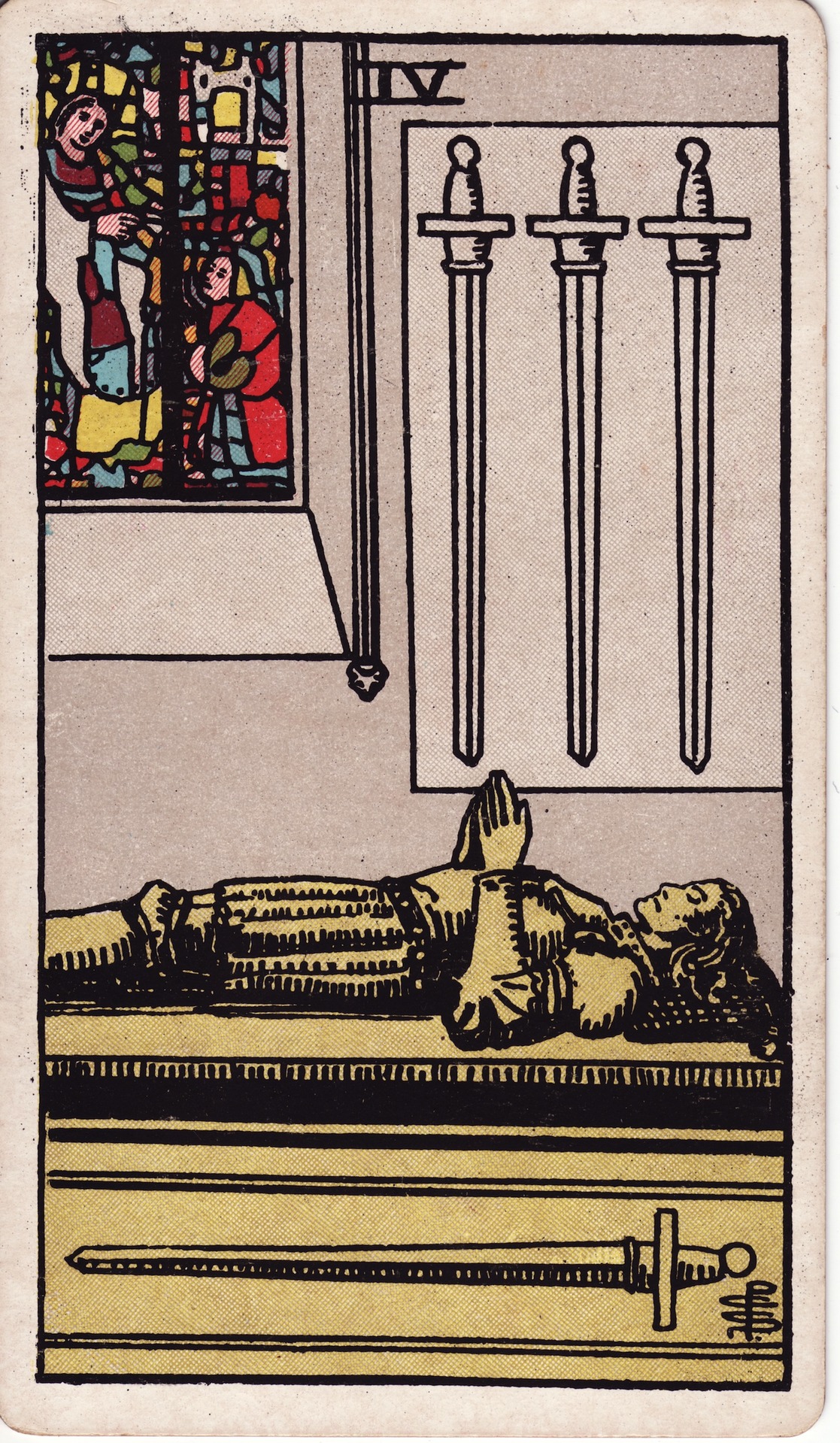
Inside a church, the effigy of a knight lies at full length on top of a tomb, his hands pressed together in prayer and his eyes closed. Three swords hang on the wall above him, points down, and a fourth lies horizontally along the side of the tomb beneath him. In the upper left corner, a stained-glass window shows a figure bending toward a smaller kneeling one, in what appears to be a scene of blessing or petition; some readers see a woman with a child there. Everything in the image is still.
Four is the number of stability and structure. In the suit of conflict, that becomes a pause. The knight has not taken off his armor, though, so this is a halt in the middle of a campaign rather than a retirement. The three hanging swords are aimed at his head and chest, the troubles that will still be there when he gets up, while the one lying under him can be read as the single matter he keeps close and lets the rest wait on.1 Waite listed vigilance, retreat, solitude, and the hermit's repose among its meanings, noting that the tomb and coffin had suggested the design.2
Upright
The Four of Swords is rest after struggle. It asks you to withdraw for a while, lay down the weapons, and let mind and body recover. The knight is not dead but still, and the card is less about an ending than about a necessary pause before the next round. Waite's meanings run through vigilance, retreat, solitude, the hermit's repose, and exile.2 It often turns up when one stage of a long effort is finished and the next has not started, and in the sequence of the suit it comes right after the heartbreak of the Three: first the wound, then the quiet room where you take stock.1
The trigger can be almost anything that has worn you down: a breakup, trouble at home, worry about money or health, a long run of conflict. The advice is to step back far enough to see the situation whole again, whether that means a day off, a trip somewhere new, or simply time with the people who steady you. It is a poor moment for big decisions.1 The card's real difficulty is that doing nothing is harder than it sounds; the task is to let the mind empty out its clutter rather than keep chewing on the problem.1
In love, it can point to a period of space: taking time apart to think, recovering after a difficult stretch, or simply a relationship that needs quiet more than discussion. At work, it can mean burnout calling for leave, a break between jobs, or the sensible decision to step back from a conflict instead of escalating it. It also suits a deliberate review after a project or a hard push: what went well, what did not, and what to do differently next time.1 It can also indicate recovery from illness; take convalescence seriously. With money, it favors holding steady and making no large moves until you are thinking clearly.
On the inner level, it is meditation, contemplation, retreat, and the kind of solitude that restores rather than isolates. Time alone can be uncomfortable, but it tends to leave you surer of yourself and more in touch with what you actually believe.1 The swords are still on the wall; the problems have not gone away. But a rested mind meets them better than an exhausted one, and the card suggests the time to rest is now, before rest is forced on you.
Reversed
Reversed, the needed rest is either refused or overdone. On one side, you keep pushing through exhaustion, ignoring warnings from your body or from the people around you, until stress turns into burnout or illness. Some readers treat this as the reversal's main message, the upright advice repeated louder: long hours or caring for others have drained you nearly dry, and if you collapse you will be no use to anyone.1 Often the mind is the culprit, racing through a to-do list while the body asks to stop. Rest does not have to be grand; an afternoon nap, a short daily meditation, a weekend away, or a break from your phone and social feeds can be enough to refill the tank.1
On the other side, retreat has gone on too long: withdrawal has become isolation, and the pause is now a way of avoiding a return to the world. The reversal can also show stagnation, nothing moving and frustration building. A long marriage may have gone hollow, and a deliberate break, with the intent to come back when things feel alive again, may help more than grinding on.1 If life seems stuck, ask how much of that comes from having waited for problems to fix themselves; that patience now has a cost.1 In relationships, distance can harden into estrangement, or one partner can shut the other out. It can also mean waking up: restlessness after a long recovery and a readiness to re-engage.
Waite's reversed meanings are unusually practical: wise administration, circumspection, economy, precaution, and testament, with a warning about avarice. His additional notes say that while the upright card is unfavorable, the reversed one promises a certain success following wise administration of affairs.2 At work and with money, this is the careful manager, budgeting tightly and planning ahead. The risk is that caution turns into stinginess; the reward is a success built on prudence.
Notes
- Biddy Tarot, "Four of Swords Tarot Card Meanings", https://www.biddytarot.com/tarot-card-meanings/minor-arcana/suit-of-swords/four-of-swords/
- A. E. Waite, The Pictorial Key to the Tarot (1911), Four of Swords, https://sacred-texts.com/tarot/pkt/index.htm