Four (4) of Pentacles
Appearance
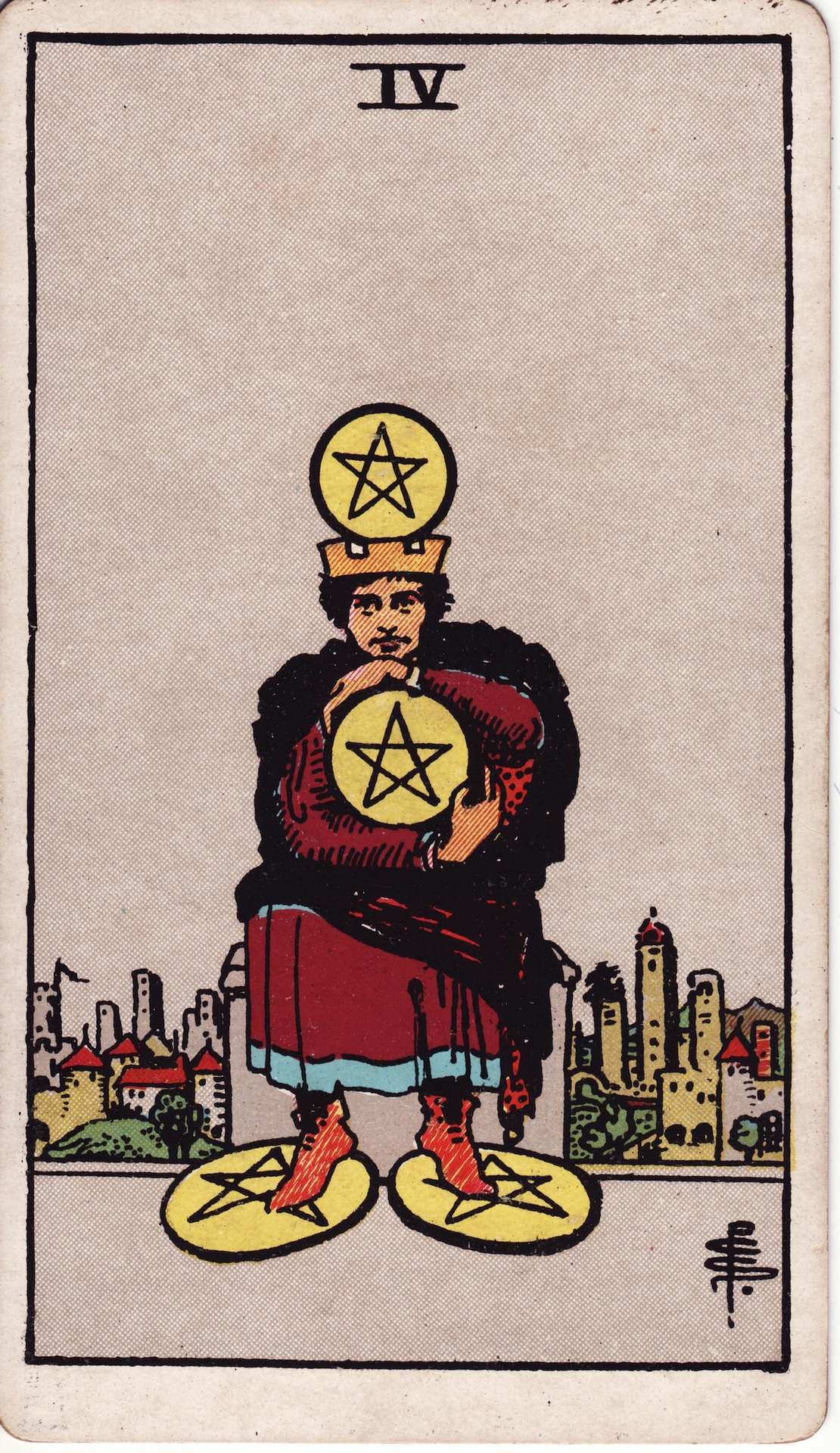
A crowned man sits squarely on a low seat, facing the viewer, with four pentacles placed around him. One is balanced on top of his crown, one he clutches against his chest with both arms wrapped around it, and his feet rest firmly on the other two. He wears a red robe with a dark cloak, and his expression is watchful. Behind him, on either side, rise the towers and roofs of a city, but he sits apart from it in an open space of his own.
In Waite's words, "He holds to that which he has."1 Four is the number of structure and stability, the square with its four corners. In the suit of earth, stability becomes possession: the security of what has been gained, and the temptation to keep a grip on it. The coins tell the rest. The one on his crown caps the place where thought, and for some readers his link to anything higher, would rise, so even his inner life is weighted down by money.2 With two coins pinned under his feet he cannot get up without losing them, and the town full of people he might talk to is at his back.2
Upright
The Four of Pentacles is the card of holding on. Waite's meanings are "the surety of possessions, cleaving to that which one has," along with gift, legacy, and inheritance.1 At its best, it is the card of financial security built through saving and good management; at its worst, it is the clenched fist that will not let anything go. A good first question is which of the two you are living: patient accumulation that still leaves room to enjoy today, or a frightened grip on every dollar.2
With money, it often points to saving, budgeting, and protecting assets, which can be wise after a period of loss or before a large expense. In its healthy form the card favors the long view: a retirement account, conservative investments, a household budget, and wealth that grows slowly because nobody is gambling with it.2 If money has been tight, it is plain advice to live within your means.2 It can also signal an inheritance or a gift that adds to your security. The caution is that frugality can harden into hoarding, driven by a sense that there will never be enough: refusing to spend even where spending would help, cutting trips, presents, and nights out with friends, or measuring every choice by what it costs. Money is a medium of exchange and does its good by moving; locked away, it buys nothing.2 A related trap is letting possessions stand in for self-worth. The bigger the house and the newer the car, the harder you must work to keep them, until there is no time left to enjoy either.2
At work, it describes guarding a position, protecting your turf, micromanaging, or resisting change because what you have feels safer than what you might gain. That is not always a flaw: when a routine already works, declining a risk for now can be the sensible call.2 In love, the card can mean possessiveness or jealousy, a fear of losing someone that turns into control. It can also point to emotional guardedness, holding back feelings to stay safe. On the inner level, the Four of Pentacles asks what you are protecting and why. Security is worth having, and money deserves respect, but not more than the people it was meant to serve.2 A man who must keep one coin on his head and two under his feet cannot easily move.
Reversed
Reversed, the grip loosens in one of two ways. The first is healthy release: letting go of possessions, habits, or control that no longer serve you, becoming more generous, or finally spending money on something that matters. Often this follows a change in values, the realization that accumulating things has not made you any happier, and it can show up as clearing out the house or choosing to live with less.2 After a long period of caution, this can feel like breathing out.
The second is the opposite extreme: money slipping away through careless spending, a sudden loss, or theft. Here the loss of control is not chosen. Sometimes the spending is a way of trying to feel better, and the shrinking balance only adds to the worry.2 It can also show the grip tightening further, into greed or miserliness. The hunger for more may mean long hours that leave family behind, or a business that squeezes its customers to lift its margins; it is worth asking plainly what the extra is costing you.2
Waite's reversed meanings are brief: suspense, delay, opposition.1 Plans may stall, a payment may be held up, or someone may block what you are trying to achieve. In love, the reversed four can mean a possessive partner learning to trust, or a relationship strained by arguments over money. A quieter reading is self-protection: when the world outside feels unstable, you build certainty where you can, and putting your own space in order, sorting drawers or tidying a room, can be a genuine comfort.2 On the personal level, it asks you to find the middle ground between clinging and carelessness, keeping what you need while allowing the rest to circulate.
Notes
- A. E. Waite, The Pictorial Key to the Tarot (1911), Four of Pentacles, https://sacred-texts.com/tarot/pkt/index.htm
- Biddy Tarot, "Four of Pentacles Tarot Card Meanings", https://www.biddytarot.com/tarot-card-meanings/minor-arcana/suit-of-pentacles/four-of-pentacles/