Three (3) of Pentacles
Appearance
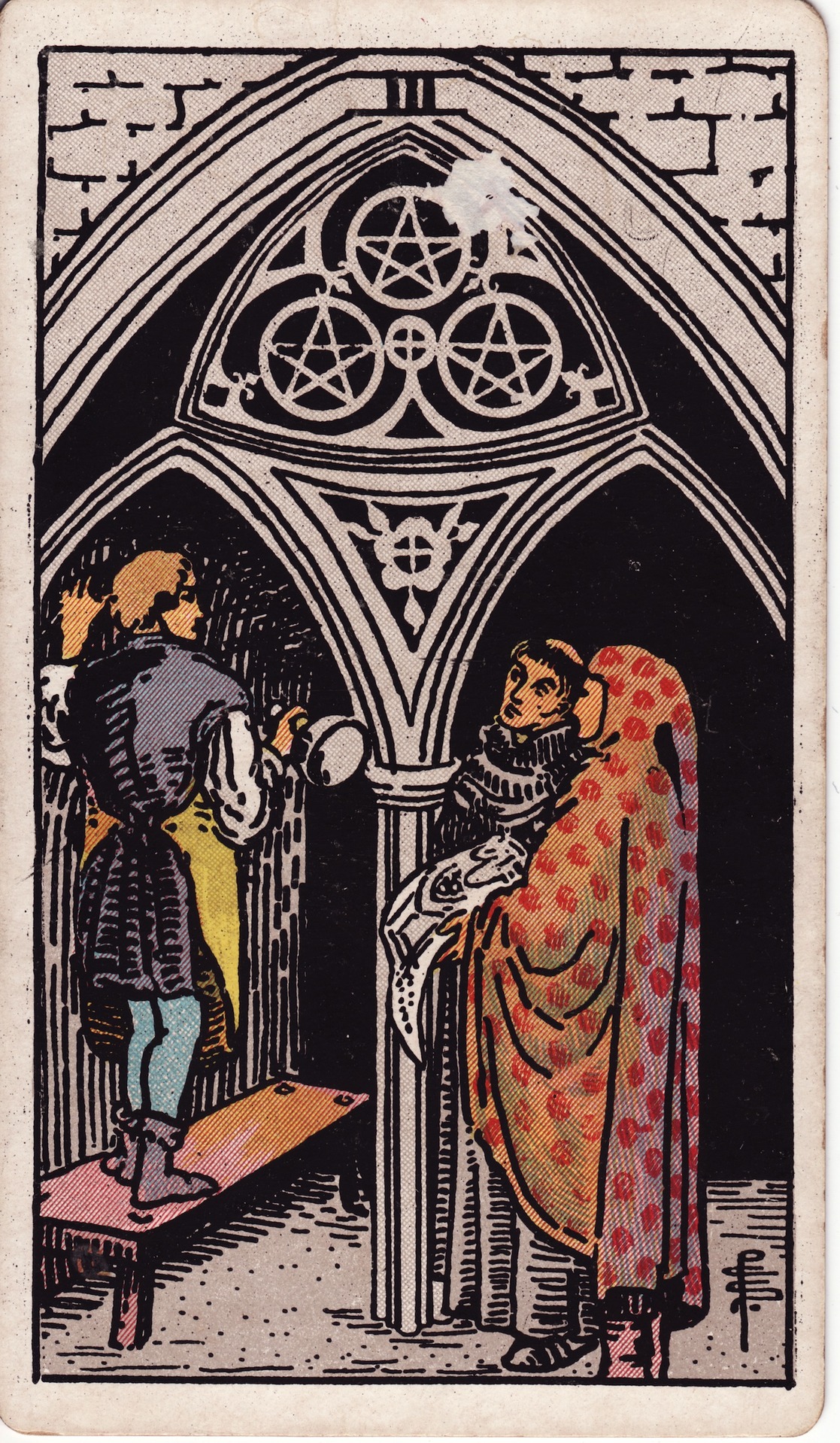
Inside a stone church, a young craftsman stands on a low bench, working on the carved stone of an arch. He wears a dark tunic and blue hose and holds a tool in his raised hand. Beside the central pillar, two figures look up at him: a monk in a gray hood, and a second person in a long orange cloak spotted with red who holds a sheet of drawn plans. Above them, three pentacles are carved into the tracery of the vaulted arch, arranged in a triangle.
Waite pairs the card with the Eight of Pentacles: the apprentice of the Eight "has received his reward and is now at work in earnest."1 Three is the number of first results, and here those results come from skill offered to others and judged by them. The scene also reads as a meeting in progress. The craftsman is the youngest and least senior of the three, yet he has paused to talk, and the two below are looking up and listening, as if comparing his progress with the drawing and asking what he knows about the stone that they do not.2
Upright
The Three of Pentacles is the card of skilled work done together. Each figure brings something the others lack: the craftsman his hands, the person with the plans a design, the monk the purpose the building serves. None of them could finish the church alone, and none is treated as lesser for having fewer years or a lower place; each listens, and each comes away having learned something from the others.2 Waite's meanings start with trade and skilled labor, and add that the card is usually read for renown and recognition.1 The work is good enough to be noticed.
Like the other Threes, it marks a stage. The Ace was the idea and the Two the weighing and planning; the Three is where the work actually starts and the first real milestone comes into sight. The building is far from finished, but it is going up, and the card is encouragement that you have the ability and the means the job requires and are heading the right way.2
At work, it often appears when a project depends on collaboration: a team that functions, a client who respects your expertise, a mentor or employer who sees what you can do. It favors asking for feedback, learning from those with more experience, and letting your competence speak for itself. Make a point of naming what each person on the team contributes; it keeps the respect running both ways.2 The card also rewards the unglamorous side of a large job: a written plan, a schedule, and someone keeping track of who is doing what.2 It is a strong card for apprenticeships, training, and the early stages of a career where the foundations are being laid properly.
With money, it suggests income earned through skill, and gains that come from doing careful work rather than chasing quick returns. In love, it describes a partnership that is actively built: two people planning together, dividing tasks, working on a home or a shared goal. On the personal level, the card asks you to take pride in craft, to do the work well even where no one may see it, and to value what others can add.
Reversed
Reversed, the collaboration breaks down. Team members pull in different directions, no one agrees on the plan, or one person is left doing the work while others take credit. Waite's reversed meanings are mediocrity in work and otherwise, pettiness, and weakness: the job done carelessly, the corner cut, the effort that never rises above good enough.1 Sometimes the friction is about status, with people competing to look most capable while newer or quieter members are talked over. Clear ground rules about respect help, as does crediting each person's part whatever their seniority.2 Where a group has simply drifted, go back to what the project was meant to achieve and agree again on how to get there, including deadlines, budget, and how much each person is expected to put in.2
At work, this can mean a project stalled by poor communication, a lack of skill or training for the task at hand, or a workplace where good work goes unrecognized. Since the upright card is so much about planning, the reversal can point to work going ahead without a plan; if you cannot say how you get from here to the goal, stop and map out the next steps in detail before going further.2 If the job itself is routine and offers no room to grow, the card may be hinting that it is time to look for a place that will actually use what you can do.2 With money, it warns against shoddy foundations: a plan without a budget, an investment you have not studied, or income that depends on effort you are not really putting in.
In love, it can point to partners who no longer work as a team, each pursuing separate goals, or one person carrying the household while the other drifts. On the inner level, the reversed three can reflect a loss of motivation or a refusal to learn from others. It can also show someone who has stopped waiting on other people and decided to handle everything personally. That instinct is sometimes sound, but if the load starts to show, accept the help on offer.2 It asks whether you need to build skill, ask for help, or simply recommit to doing the work properly.
Notes
- A. E. Waite, The Pictorial Key to the Tarot (1911), Three of Pentacles, https://sacred-texts.com/tarot/pkt/index.htm
- Biddy Tarot, "Three of Pentacles Tarot Card Meanings", https://www.biddytarot.com/tarot-card-meanings/minor-arcana/suit-of-pentacles/three-of-pentacles/