Justice (XI)
Appearance
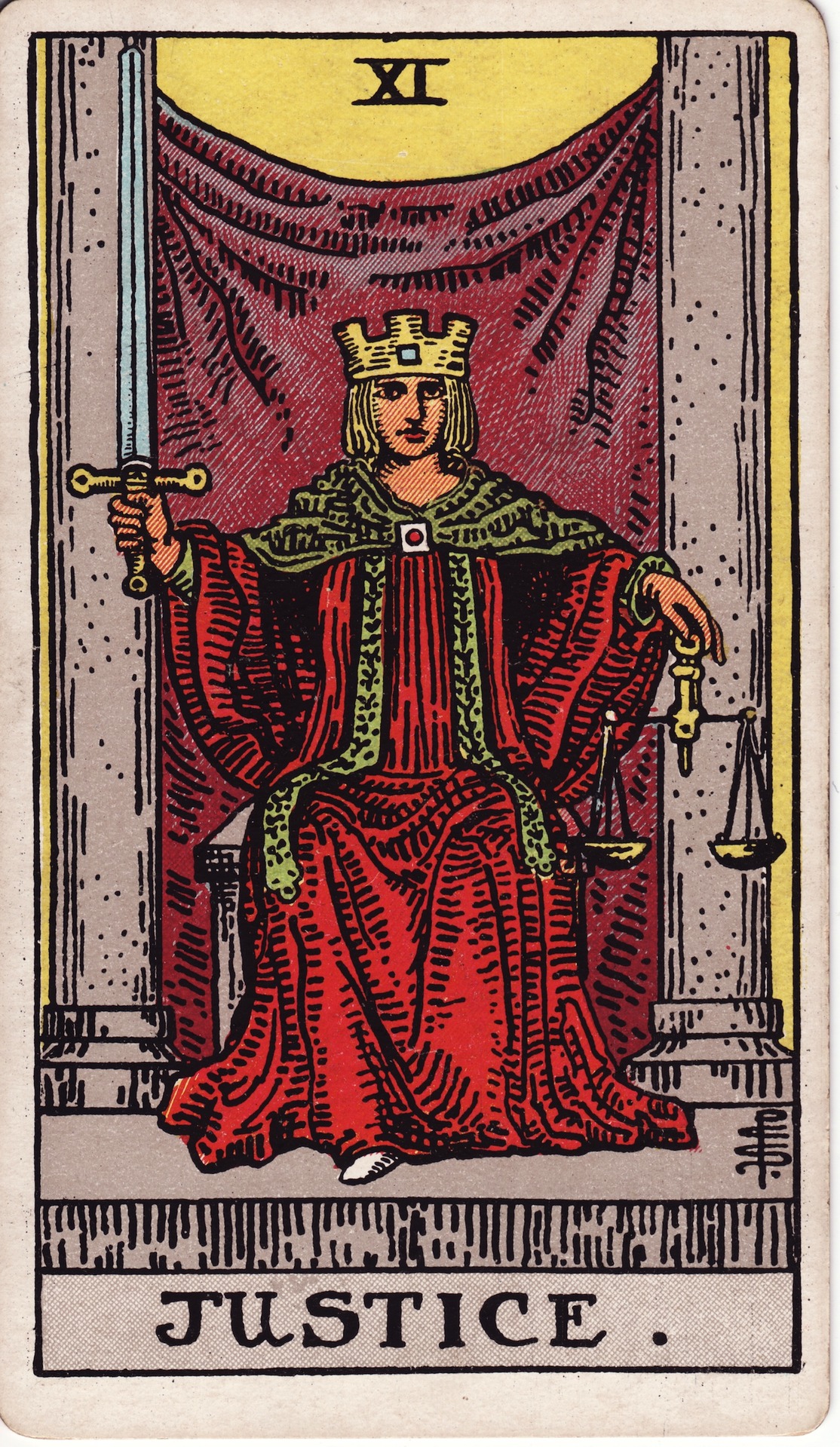
A crowned figure sits on a stone seat between two gray pillars, with a purple veil hung behind her and a band of yellow sky above it. She wears a red robe under a green cloak fastened with a square clasp, and her crown is squared like a battlement, set with a small square jewel. Her right hand holds a double-edged sword straight up; her left holds golden scales loosely at her side. She looks directly out of the card, and a white shoe peeks out beneath her hem.
In the Rider-Waite-Smith deck Justice is numbered eleven and Strength eight, the reverse of the older order, a swap Waite made without explaining it.1 He said her pillars, unlike the High Priestess's, open onto the moral law that deals with each person according to their works.1 The raised blade reads as a verdict reached, its two edges a warning that every act cuts back toward its maker. The scales sit in the left hand, often linked with intuition, so reason is weighed against feeling. The veil adds mercy, the square jewel a mind kept in order, and the white shoe hints that our choices are tallied beyond the courtroom too.2
Upright
Justice is the card of cause and effect, of fair judgement and of truth told plainly. What has been done will be weighed, and the outcome will follow from the facts rather than from wishes or excuses. If you have acted honestly and with others' good in mind, there is little to fear; if not, expect the matter to come to light. Even then the weighing is fair rather than cruel, and a regretted mistake is judged without prejudice.2 Waite's meanings are equity, rightness and probity, and he adds a very practical one: the triumph of the deserving side in law.1 When the card appears around a contract, a dispute or a court case, it generally favors whoever has acted honestly. It also tends to say the ruling is near and final: once it comes, accept it and move on rather than hoping for a second hearing.2
In relationships, Justice asks for fairness and accountability on both sides. It can point to an honest conversation that clears the air, a commitment entered with open eyes, or, where a relationship is ending, a settlement that is equitable rather than punishing. At work, it favors clear agreements, fair evaluation and decisions made on the evidence; it can also mean a formal process such as an audit, a hearing or a negotiation. With money, it is a card of balanced books and of paying what is owed.
The inner side of Justice is responsibility. The sword is double-edged, and the card asks you to look at your own part in a situation as clearly as you look at anyone else's. It often turns up before a choice whose effects will last, for you and for the people near you. Reason it through, then check it against your gut and ask what would serve everyone involved.2 A useful test is whether you could own the results without flinching; if not, keep digging until you reach a position you can defend.2 Beneath all of this is a search for truth, and the honest finding is usually that fairness is less simple than it first looked. Expect to question your own ideas of right and wrong.2
Reversed
Reversed, the scales are out of true. The card can point to unfairness: a decision that goes against you without good reason, a dispute that drags on, or a system that favors whoever has more power. Waite's reversed meanings lean heavily on the law itself: legal complications, bigotry, bias and excessive severity.1 A contract may hide unfavorable terms, or a legal matter may become more tangled and expensive than expected. If you are already in one, you may distrust the process, expect a slanted verdict, or want to contest the result.2
The reversal is just as often personal. It can describe avoiding accountability, blaming others for what you had a hand in, or being dishonest with yourself about why something went wrong. Sometimes it is quieter: you know you did wrong and nobody has noticed yet, and the question is whether to keep it buried or come forward and repair it. Either way your conscience carries the result.2 In relationships this may look like a partner who will not own their part, or one person keeping score while the other gives more. At work, watch for unfair treatment, office politics that override merit, or the temptation to cut corners in the hope that no one checks.
The card can also turn the judgement inward too hard, so that every misstep gets replayed as if you were your own prosecutor. Here the corrective is mercy: everyone gets things wrong, and the critic has done its job once it has shown you the problem.2 If you are the one deciding something that affects others, check whether a prejudice is tipping the scale, and gather more facts before you rule.2
The remedy is the upright card's virtue: tell the truth, take responsibility for your share, and correct what you can. Owning a mistake tends to lift the guilt that hiding it keeps alive.2 Where the injustice really does come from outside, document carefully and seek fair counsel rather than answering bias with severity of your own.
Notes
- A. E. Waite, The Pictorial Key to the Tarot (1911), Justice, https://sacred-texts.com/tarot/pkt/index.htm
- Biddy Tarot, "Justice Tarot Card Meanings", https://www.biddytarot.com/tarot-card-meanings/major-arcana/justice/