King of Swords
Appearance
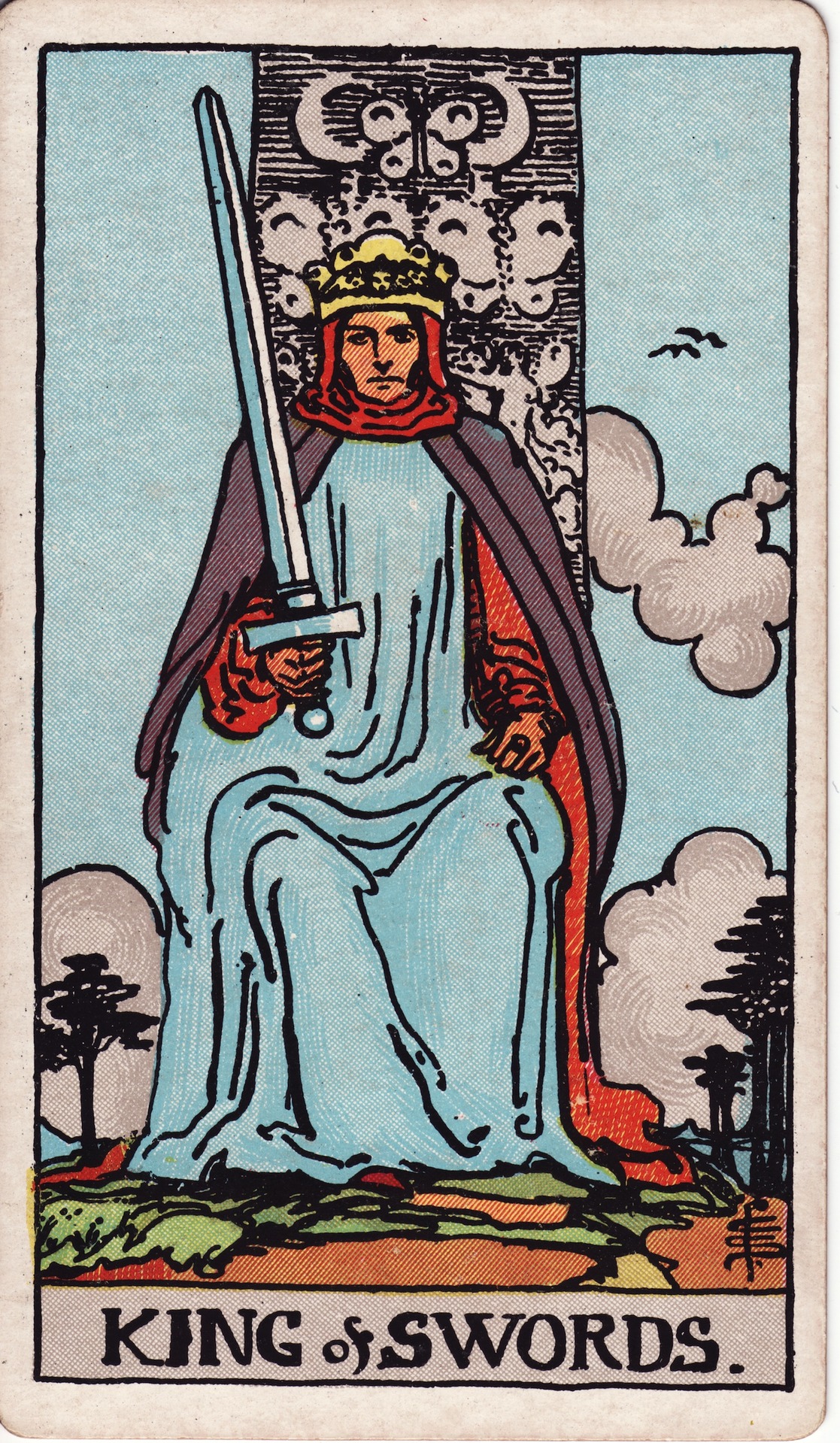
The king sits facing straight out of the card on a tall stone throne, holding an unsheathed sword upright in his right hand, tilted slightly to one side. His left hand rests on his knee. He wears a pale blue robe under a purple cloak lined with red, a red hood, and a gold crown, and his expression is calm and serious. The high back of the throne is carved with butterflies and crescent moons, and a small winged figure sits close beside his head. Around him the sky is clear blue, with low clouds, two birds in flight, and a few dark trees at either side.
Waite noted that the king recalls the figure of Justice among the trumps, but said he is rather "the power of life and death, in virtue of his office."1 Kings show the outward authority of their suit; in swords, that is judgment, law, and command. The blade, held by the hand of reason but leaning toward the side of instinct, can be read as logic that still listens to hunches; the winged figure seems to whisper advice. The wind that drives the lower Swords courts has dropped here, leaving the scene still.2
Upright
The King of Swords is authority grounded in intellect: clear judgment, fairness, and the ability to make hard decisions without being swayed by sentiment. Waite's meanings are whatever arises from the idea of judgment: power, command, authority, militant intelligence, law, and offices of the crown.1 His additional notes name the professions this king can represent: a lawyer, a senator, or a doctor.1
When the card describes you, it shows you speaking from conviction and being listened to because of it. You can see a situation for what it is, including the habits of your own that are holding it back, and you are in a position to give the impartial view others cannot. It may feel less warm than you would like to set feelings aside and go straight to the core of a problem, but for now that cool distance is exactly what is needed.2
As a person, the King of Swords is analytical, principled, articulate, and impartial. He may be a judge, an expert, a senior advisor, or anyone whose word carries weight because it rests on reason and evidence. He is fair, but he can seem distant, and he expects others to meet his standards. Often he is a paid specialist, an attorney, accountant, or tax advisor with a strong reputation and a steep rate, who shows little interest in your life beyond the question he was hired to answer. That narrowness is part of his value.2
In love, he can represent a partner who is honest and dependable but reserved, or the need to think clearly about a relationship rather than react. At work, he suits leadership, strategy, legal or technical roles, and situations calling for a firm, well-reasoned decision. With money, he favors professional advice, contracts read carefully, and choices based on facts. If you have not yet consulted an expert, the card suggests doing so, ideally before a foreseeable change arrives, so you already know your rights when it does; a mentor or advocate can serve the same purpose.2 Inwardly, the card asks you to take responsibility for your decisions, to speak with authority, and to let principles rather than moods guide you.
Reversed
Reversed, the king's authority is turned to the wrong ends. Waite's reversed meanings are blunt: cruelty, perversity, barbarity, perfidy, and evil intention.1 Intelligence becomes manipulation, judgment becomes tyranny, and the power to decide is used to control or punish.
There is a gentler reading as well. The inverted king can stand for authority that is turned inward rather than displayed: someone who does not dominate meetings or seek an audience, but who knows their values and cannot easily be talked out of them. Their strength is quiet and self-sourced, and it is no less real for being unseen.2
As a person, the reversed King of Swords may be cold, domineering, or calculating, someone who uses rules and arguments to get his way and shows little concern for the people he affects. He may abuse a position of power, twist the truth, or hold grudges. He may also show off his intellect, using jargon and obscure subjects to make others feel small, and his sharp tongue can be attractive at first; be careful, since his own interests come first.2 Waite's additional notes call him simply a bad man.1
In love, this can mean a partner who is controlling or emotionally withholding, arguments that are won by intimidation, or affection and intimacy held back as a form of punishment.2 At work, it warns of an unfair boss, a misuse of authority, or decisions made for selfish reasons. In money and legal affairs, the same notes carry a specific caution: put an end to a ruinous lawsuit before it costs more.1
The reversed king can also describe your own judgment failing, through indecision, rigidity, or an unwillingness to listen. Sometimes the mind simply will not settle: you cannot tell which option is best, worry crowds out thinking, and choices that need making are put off while nothing moves.2 Seek fair counsel, check your motives, and let fairness rather than force settle the matter.
Notes
- A. E. Waite, The Pictorial Key to the Tarot (1911), King of Swords, https://sacred-texts.com/tarot/pkt/index.htm
- Biddy Tarot, "King of Swords Tarot Card Meanings", https://www.biddytarot.com/tarot-card-meanings/minor-arcana/suit-of-swords/king-of-swords/