Queen of Swords
Appearance
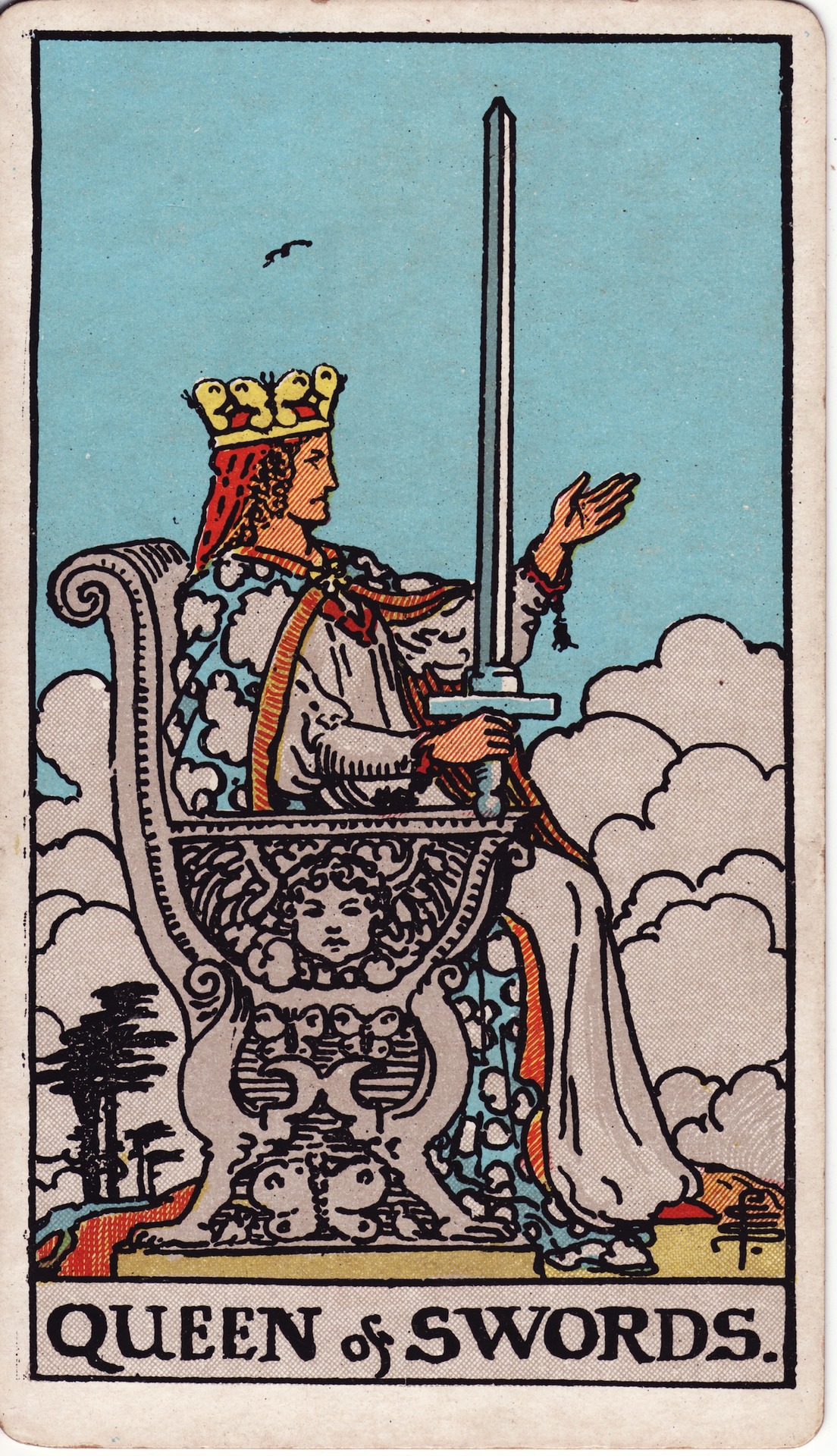
The queen sits in profile on a high stone throne, facing right, with her sword held straight up in her right hand. Her left hand is raised and open, reaching outward, and a tassel hangs from her wrist. Her crown is decorated with butterflies, and the throne beneath her is carved with more butterflies and the face of a winged child. She wears a pale gown with a cloak patterned in clouds. Clouds gather around the base of the throne, a single bird flies high above her, and a few dark trees stand at the left.
Waite described her face as severe but chastened, suggesting familiarity with sorrow, and noted that she does not represent mercy.1 Queens embody the inward mastery of their suit; for swords, that means clear perception tempered by experience. The winged child on her throne hints at a gentler self she keeps out of view, and the butterflies signal change and rebirth. The upright blade is her commitment to the truth; the open left hand waits to take something in. She looks toward what is coming, and the clouds and wind say this suit's weather is still changing.2
Upright
The Queen of Swords is clear-sighted independence. She sees situations as they are, speaks plainly, and makes decisions with her head rather than her heart, not because she lacks feeling but because experience has taught her the cost of illusion. Waite's meanings are sorrowful: widowhood, sadness, absence, mourning, privation, and separation, and his additional notes call her simply a widow.1 Modern readers draw these together into a figure whose wisdom has been earned through loss.
What keeps her from being merely cold is that she is still a queen, receptive as well as sharp. She listens to other views and weighs them, then sorts what holds up from what does not, and the final judgment stays hers. She tends to relate to people by understanding how they think and why they act rather than through shared feeling, and she wants the full picture before she decides anything.2
As a person, the Queen of Swords is perceptive, articulate, and fair, with high standards and little patience for flattery, gossip, or idle talk. She may be a mentor, a professional who deals in facts, or someone who has come through grief or hardship with her judgment sharpened rather than broken. Because her answers come without padding, people seek her out when they are confused and need someone to cut through it.2 Her extended hand suggests she is willing to help, on honest terms. Her boundaries hold not because she threatens anyone but because she says early on what she will and will not accept, and she can seem intimidating until trust is built and her warmth shows.2
In love, she can point to someone who values independence and needs clear communication, or to a period of being single by choice. At work, she suits editing, law, analysis, and management, any task that requires objectivity and boundaries. With money, she budgets honestly. Inwardly, she asks you to tell yourself the truth, set clear limits, and let past pain inform you rather than harden you.
Reversed
Reversed, the queen's clarity hardens into coldness or sours into cruelty. Waite's reversed meanings are malice, bigotry, artifice, prudery, bale, and deceit, and his additional notes describe a bad woman with ill will toward the querent.1 Truth is used as a weapon, criticism is constant, and standards become a way to keep others at a distance.
As a person, the reversed Queen of Swords may be bitter, judgmental, manipulative, or sharp-tongued, someone whose own unhealed hurt makes her quick to wound. She can also be a person who has shut down emotionally to avoid feeling anything at all. Whether the card describes someone you are dealing with or a side of yourself, that hardness has a price: allies drift away, a reputation for rigidity and unkindness sets in, and she ends up alone.2
In love, this can mean coldness, harsh words, or a partner who keeps score. At work, watch for a critical manager, gossip, or decisions made without regard for the people affected. With money, it can mean being so guarded that you will not invest in anything.
The reversal can also point the other way: clarity overwhelmed by emotion, so that judgment is clouded and boundaries collapse. Being too close to a situation bends what you see, and the fix is to step back and read the facts again.2 A quieter version is clarity lost to other people: deferring to a stronger voice, or shelving a plan because keeping the peace feels safer than upsetting anyone. Here the card asks for more spine, a careful look at every option without feeling bound to take any of them, and the confidence to act on what you conclude.2 Either way, the path back is to let feeling and reason work together, honest without being cruel and open without giving up your own perspective.
Notes
- A. E. Waite, The Pictorial Key to the Tarot (1911), Queen of Swords, https://sacred-texts.com/tarot/pkt/index.htm
- Biddy Tarot, "Queen of Swords Tarot Card Meanings", https://www.biddytarot.com/tarot-card-meanings/minor-arcana/suit-of-swords/queen-of-swords/