Seven (7) of Swords
Appearance
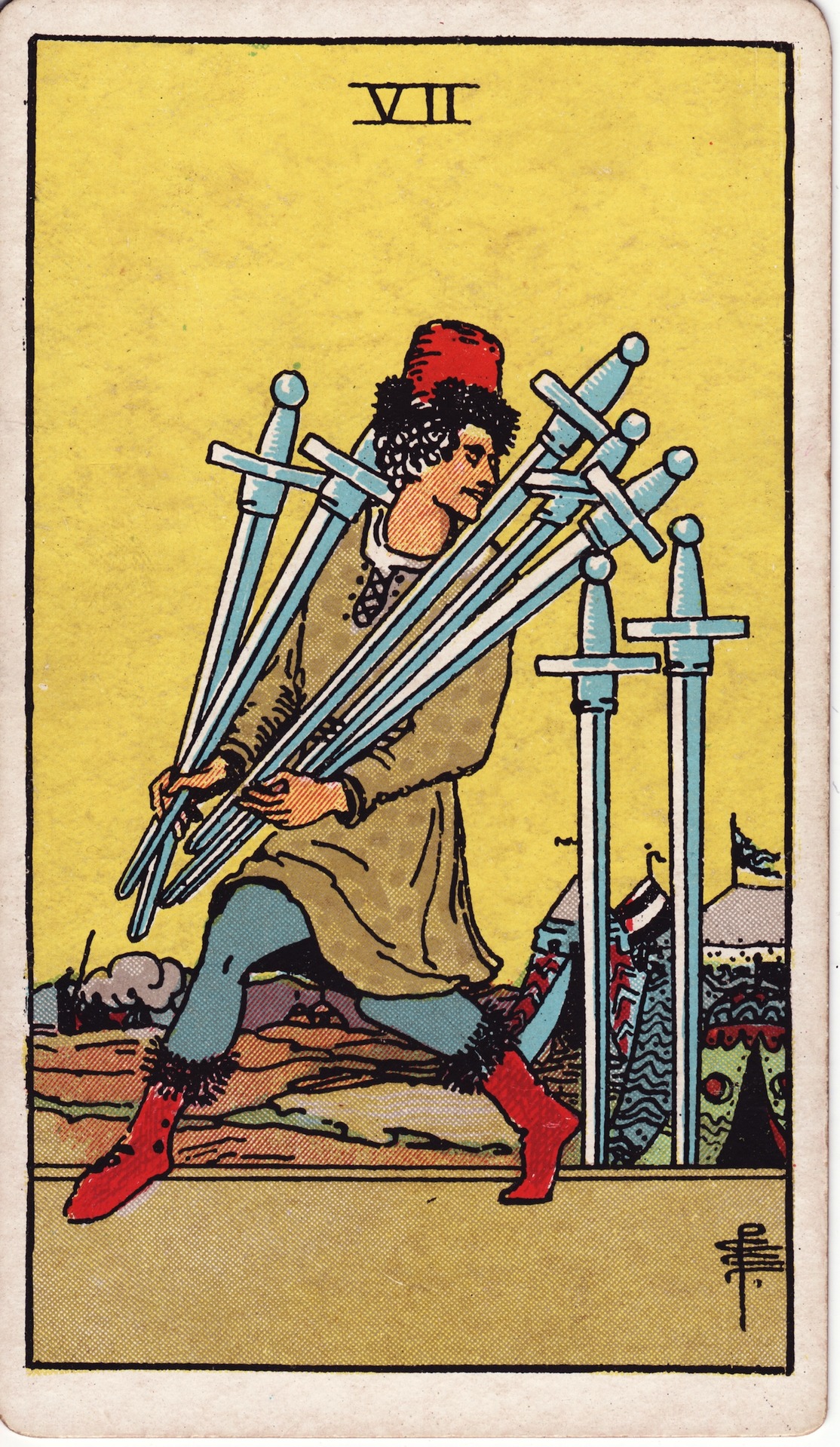
A man in a red cap and a short tunic tiptoes away from a military camp with his arms full of swords. He carries five of them clutched together in a bundle, hilts up, and looks back over his shoulder toward the tents with a sly half-smile. Two more swords remain standing upright in the ground behind him. The tents are colorful and topped with small flags, and in the far distance on the left a small group of figures stands near what looks like a cloud of smoke. The sky is a flat, bright yellow. His grin reads as satisfaction at having slipped out unseen, and the backward glance is aimed at the two swords he could not manage to carry.1
Waite admitted that this card was hard to pin down, saying that its significations are widely at variance with each other.2 Sevens in the minor arcana often concern effort, strategy, and testing; in the suit of air they become cunning.
Upright
The Seven of Swords is the card of strategy, stealth, and getting away with something. Someone is acting alone and in secret, taking what they want while hoping no one notices. That someone may be another person, or it may be you. Waite's meanings are mixed: design, attempt, wish, hope, and confidence, but also quarreling, a plan that may fail, and annoyance.2
If you are the one sneaking, the card asks what it will cost. Even a scheme that is never discovered has to be maintained, and keeping a story straight can take more energy than the prize was worth.1 If someone else is sneaking, you may not see it yet: a person you rely on could be quietly pursuing a private agenda. When an offer seems too generous, or a friend's account does not quite add up, trust that uneasy feeling.1
In love, the card can point to deception: a secret kept from a partner, an affair, or one person not being straight about what they want. It can also mean a relationship conducted carefully and privately for good reasons. At work, it describes maneuvering: office politics, someone taking credit for your work, a competitor's trick, or the need to protect your ideas. With money, it warns of theft, fraud, or a deal that is too clever by half.
There is a more neutral reading as well. Sometimes the situation calls for tact and a quiet plan rather than open confrontation, and the card endorses doing things your own way. The thief could not carry all seven swords, and you may also have to pick the few tasks that actually move you forward and leave the rest standing.1 It can mean going around a process instead of through it, such as appealing directly to whoever makes the decision after the official channel has said no.1 It can also mean putting your own priorities ahead of what others expect, and accepting that someone will be disappointed.1 The question is whether you are being resourceful or simply dishonest, and whether the two swords left behind will be missed. Plans that depend on no one noticing tend not to hold.
The figure is, after all, leaving. The card can describe slipping away from something you would rather not face, such as a commitment, a heavy workload, or a relationship, or letting a problem sit until it has grown worse.1
Reversed
Reversed, the scheme comes into the open. A deception is discovered, a secret is confessed, or someone who has been getting away with something is caught. If you have been the one hiding, this can mean coming clean and dealing with the consequences; if you have been deceived, it may mean finally learning the truth. In an affair, it can show one or both people tiring of the pretense and wanting the thing either ended or brought out where others can see it.1
A secret carried for a long time weighs on its keeper, and guilt and shame grow best in the dark. The reversed card can mark the point where telling someone becomes less frightening than staying quiet. Go easy on yourself first, then choose one person you trust and say it out loud.1
It can also mean deceiving yourself: telling yourself a story that excuses a habit, avoiding a hard look at your own behavior, or running from a problem instead of facing it. A less common reading turns the thief's guilt inward, so that you feel like the impostor, as if you had taken a role or a success you did not earn and will soon be found out. That is usually fear rather than fact, and the evidence that you belong is generally already there.1 In relationships, trust may need to be rebuilt after something hidden comes to light. At work, a plan may unravel, or you may realize you have been trying to do everything alone when you need help.
Waite's reversed meanings are good advice, counsel, and instruction, along with slander and babbling, and his additional notes give good advice, probably neglected.2 In this reading the card is a message from someone wiser that you would do well to hear. Listen to it, check what is being said about you and by whom, and choose openness over cleverness.
Notes
- Biddy Tarot, "Seven of Swords Tarot Card Meanings", https://www.biddytarot.com/tarot-card-meanings/minor-arcana/suit-of-swords/seven-of-swords/
- A. E. Waite, The Pictorial Key to the Tarot (1911), Seven of Swords, https://sacred-texts.com/tarot/pkt/index.htm