Eight (8) of Swords
Appearance
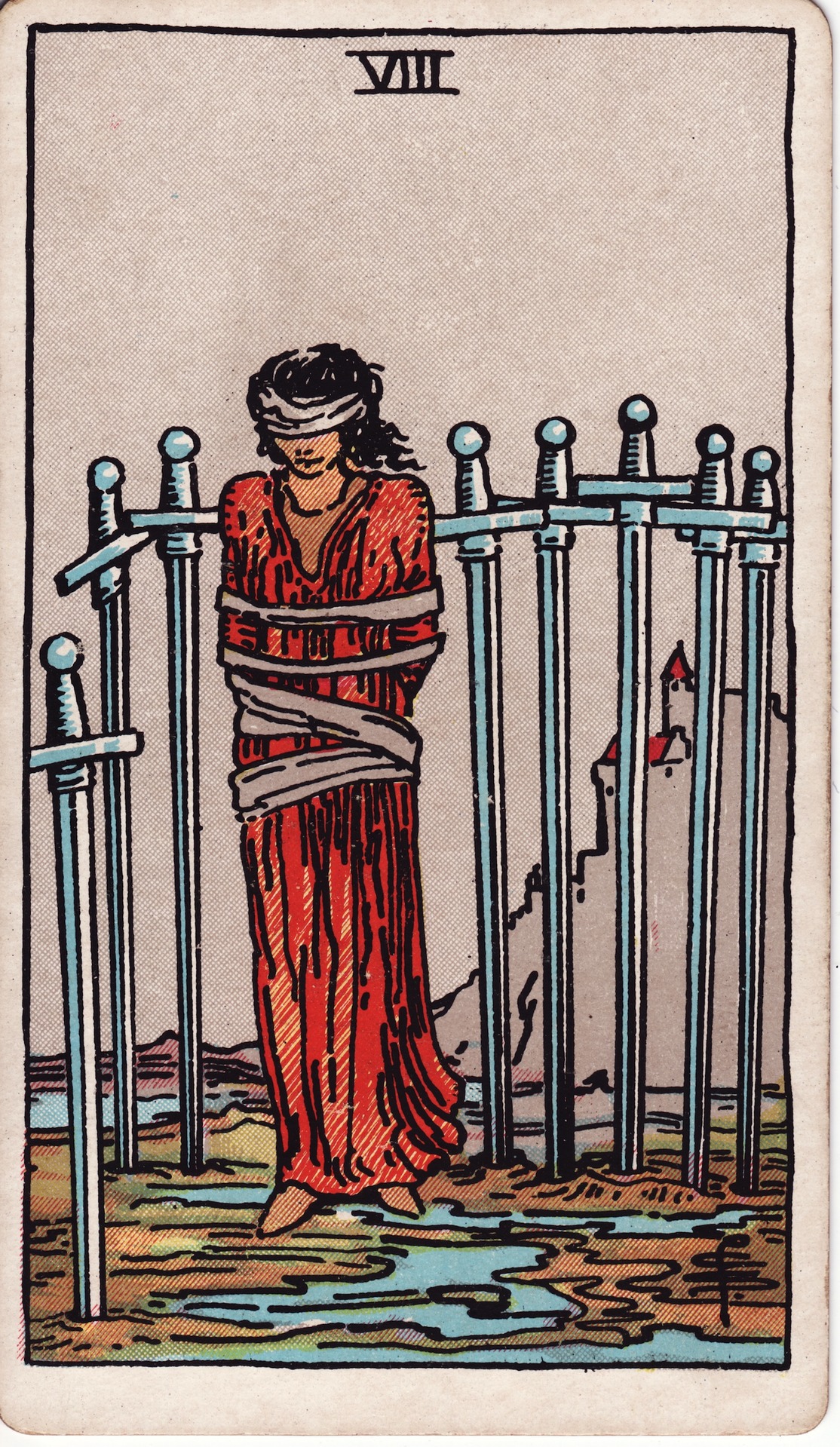
A woman in a long red robe stands blindfolded, her upper body and arms wrapped tightly in strips of gray cloth. Eight swords are planted in the ground around her, three on one side and five on the other, forming a loose fence that does not quite close her in. Her feet are not tied. She stands on marshy ground scattered with pools of water, and behind her, on a rocky cliff in the distance, a castle looks down on the scene. The sky is a plain, empty gray.
Waite called it a card of temporary durance rather than irretrievable bondage.1 Eights in the tarot often deal with movement and power; here that power is held in check, restrained partly by real bonds and partly by the simple inability to see. The water under her feet offers a quieter clue: water is the element of feeling and intuition, so even blindfolded she has another sense to go by, one that can register what her eyes are kept from.2
Upright
The Eight of Swords is the card of feeling trapped. The way out is not obvious, the options seem closed, and every direction looks like it leads to another blade. Yet the image is careful: the bindings are loose, the swords do not surround her, and her feet are free. Much of the prison here is made of fear, doubt, and the stories the mind tells about what is and is not possible. Swords are the suit of thought, and this card often shows thinking turned against the thinker: going over the problem again and again, rehearsing only the worst outcome, and feeling more stuck with each pass.2 Waite's meanings include bad news, crisis, censure, conflict, calumny, power in trammels, and also sickness.1
In love, it can describe feeling stuck in a relationship you do not know how to change or leave, or being held back by fear of being hurt again. Sometimes it is the paralysis of being half in and half out, still hoping things improve while already looking at the door, and afraid that either choice will go badly.2 At work, it points to feeling boxed in by a job, a manager, or circumstances, unable to see options that may actually be there. With money, it can mean debt or obligations that feel inescapable. More broadly, it can describe a life that has drifted out of line with who you are, kept in place mostly by the belief that nothing else is available.2
The card does not deny that the situation is real. It asks you to question how much of the restriction is fixed. A common reading adds a harder question: whether you have handed your power to someone or something outside you and are now waiting to be rescued. The choices may all be unappealing, but having only bad choices is not the same as having none.2 Take the blindfold off: ask for help, gather information, take one small step. Help may already be on offer, or an option may be sitting there unexamined, and the means to act are often closer than they seem.2 When thinking only tightens the knot, set it aside and check what your gut says. The way out often begins with noticing the gap between the swords.
Reversed
Reversed, the bindings begin to loosen. The person who felt trapped starts to see a way out, regains some sense of agency, or simply decides that the situation is not as hopeless as it seemed. This can be the moment of leaving a stifling job or relationship, or of accepting help after a long time of refusing it. On the inner level, it often means facing the fear or self-criticism that has kept you stuck and finding it weaker than you thought. Looking back at what helped you through hard stretches before, and owning your part in where you stand now, keeps the release from being temporary.2
It can also show the opposite: sinking further into helplessness, or becoming so anxious that every option looks dangerous. Here the reversal makes the inner prison worse rather than opening it. Some readers put the weight on this side and read the reversed card as the inner critic at full volume, the voice that finds a flaw in every attempt until you stop attempting. It also shows up as quiet rules you hold about yourself, such as that money is not meant for you or that it is too late to get healthy, which then come true because you act on them. The work is to notice these thoughts as they arrive and interrupt the loop, and to clear out old habits and buried matters that keep the bonds in place.2
Waite's reversed meanings are disquiet, difficulty, opposition, accident, treachery, what is unforeseen, and fatality, so the traditional reading warns of trouble from outside rather than within. His additional notes give the departure of a relative.1 In work and money, be watchful for setbacks you could not have predicted. Whatever the source, the advice is the same: move carefully, one step at a time, and keep your eyes open.
Notes
- A. E. Waite, The Pictorial Key to the Tarot (1911), Eight of Swords, https://sacred-texts.com/tarot/pkt/index.htm
- Biddy Tarot, "Eight of Swords Tarot Card Meanings", https://www.biddytarot.com/tarot-card-meanings/minor-arcana/suit-of-swords/eight-of-swords/