Ten (10) of Swords
Appearance
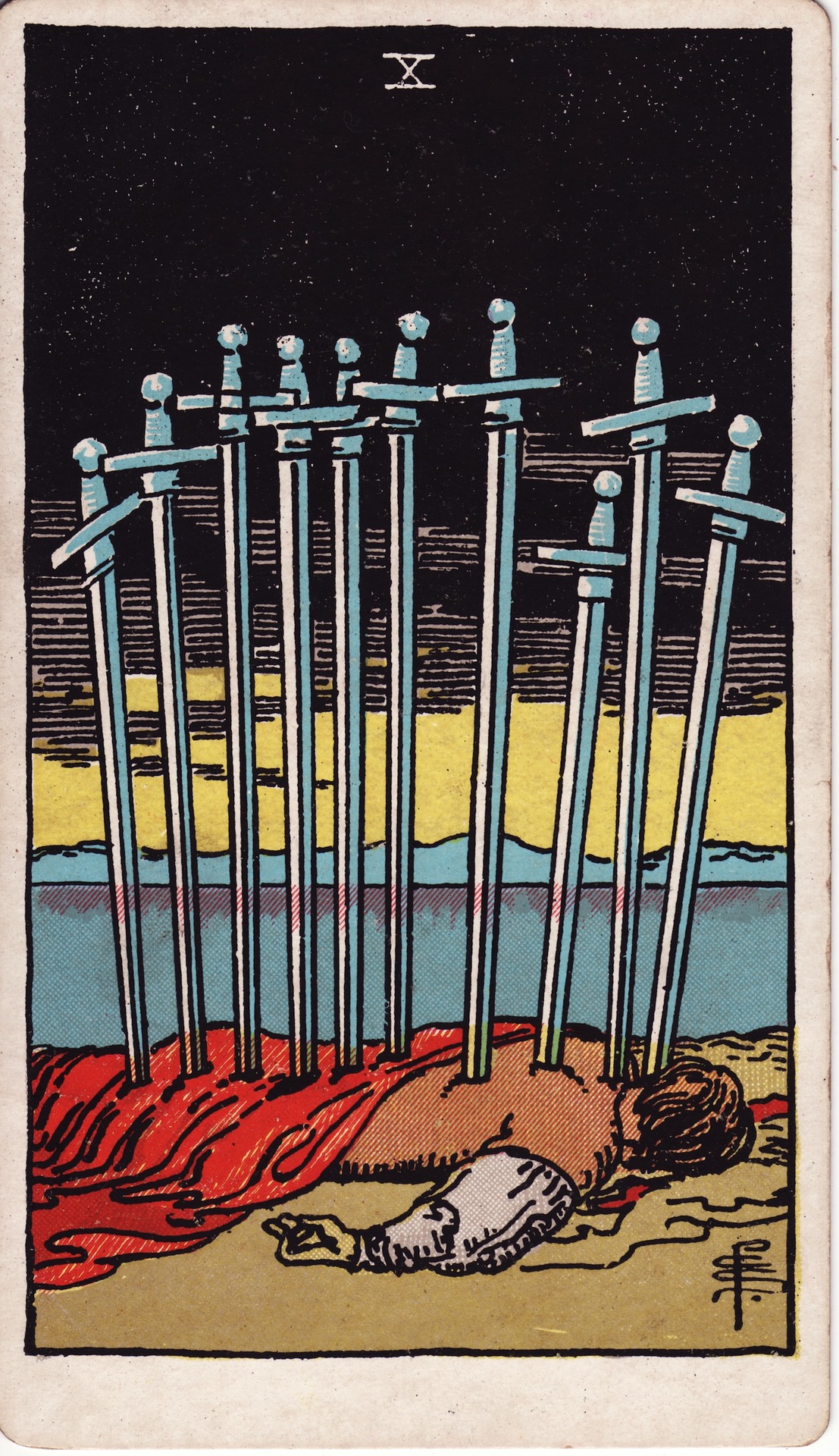
A man lies face down at the edge of still water, a red cloth over his lower body, with ten swords driven into his back from neck to waist. The sky above him is black. Yet along the horizon the darkness breaks into a band of yellow light over calm water and distant hills, as if dawn is coming. His right hand, turned toward the viewer, forms a gesture that resembles a blessing.
The image is deliberately excessive: one sword would have been enough. Waite described it simply as a prostrate figure pierced by all the swords of the card, and added that it is not especially a card of violent death.1 The red cloth can be read as a last courtesy, a covering that leaves the fallen man some dignity even here.2 The water is worth noticing too: it lies flat and untroubled beside the wreckage, a hint that some quiet is still within reach at the worst moment.2
Upright
The Ten of Swords is the card of an ending that has fully arrived. Something has collapsed, been lost, or been taken, and there is no further to fall. Waite's meanings are blunt: pain, affliction, tears, sadness, desolation.1 The card often appears at the lowest point of a difficult period, when the situation can no longer be repaired and holding on only prolongs the hurt. Often the blow lands with no warning, and the shock can leave you doubting that you will ever trust, love, or find steady work again.2
In love, it can mean a painful breakup, the discovery of a betrayal, or the final acknowledgement that a relationship is over. At work, it points to job loss, a canceled contract, a project that fails outright, or being undermined by someone you trusted, perhaps through gossip passed around behind your back.2 Betrayal is the card's most familiar theme, and the deepest part of that wound is often not the act itself but the knowledge that things with that partner, colleague, or relative can never go back to what they were, which is a second loss to grieve.2 It can also describe exhaustion: carrying more than anyone could, until something gives way.
A harder message hides here as well. The figure on the ground can become a role: lying still in the hope that someone will notice, feel sorry, and do the rescuing.2 What another person did cannot be undone, but how you answer it is still yours to decide, and the card eventually asks you to make that choice.2
Yet the card is not without hope, and its own picture says so. The swords are all spent; nothing worse is hidden behind them, and that particular source has no more harm left to deal.2 The light on the horizon belongs to the same scene as the body on the shore. The advice is to let the ending be an ending, to take its full weight rather than bracing against it, to grieve it honestly, and to resist the temptation to keep reliving it.2 Recovery begins only once you stop trying to stand up with the swords still in place. Afterward, looking back at what happened and why is what turns a defeat into something you can use.2
Reversed
Reversed, the Ten of Swords is usually the first movement of recovery. The worst has passed, and you are beginning to pull the swords out one at a time: healing after a loss, learning from a betrayal, finding your footing after a job or relationship has ended. Turned upside down, the swords even look as if they are loosening and about to drop away on their own.2 There may still be pain, but the direction has changed.
It can also mean resisting an ending that has already happened, dragging out a situation that needs to be let go, or reliving an old wound long after it could be healed. In relationships, this can look like returning to someone who hurt you, or refusing to accept that something is finished. Every delay stretches the misery out further, and a quick, clean finish usually costs less than a slow one.2
Sometimes the wound is older and better hidden. An ending from years ago may have been pushed so far down that you no longer notice it, though it still shapes how you act, and the reversed card can ask you to go back and finally deal with it.2 Once that is done, it becomes easier to see what the loss freed up, and to drop habits, commitments, or ideas about yourself that no longer fit.2
Waite's reversed meanings are unexpectedly bright: advantage, profit, success, favor, power and authority, but with the warning that none of these last.1 A narrow escape or a sudden turn of luck is possible. Take it, and use the respite to rebuild on firmer ground rather than assuming the reversal is permanent.
Notes
- A. E. Waite, The Pictorial Key to the Tarot (1911), Ten of Swords, https://sacred-texts.com/tarot/pkt/index.htm
- Biddy Tarot, "Ten of Swords Tarot Card Meanings", https://biddytarot.com/tarot-card-meanings/minor-arcana/suit-of-swords/ten-of-swords/