Nine (9) of Swords
Appearance
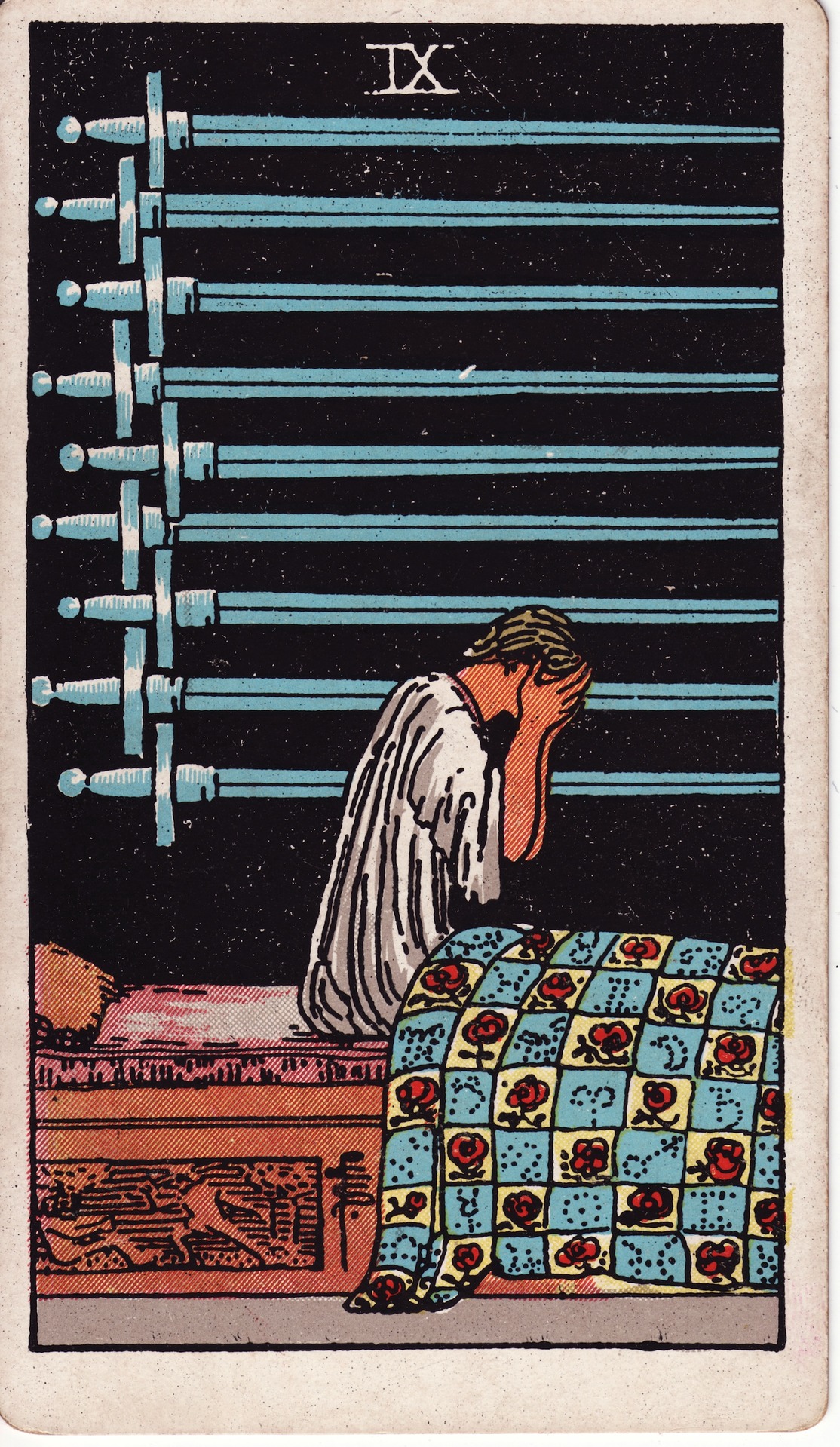
A woman sits up in bed in the dark, her face buried in her hands. Behind her, nine swords hang horizontally against a black background, one above the other, filling the upper half of the card. She wears a plain white nightgown. Her bed is covered with a quilt of squares, some decorated with red roses and others marked with small symbols usually read as astrological signs. Carved into the side of the bed is a small scene that appears to show one figure attacking another.
Waite described her as one who knows no sorrow like hers, and called it a card of utter desolation.1 She looks like someone who has just woken from a bad dream and cannot shake it. The swords are stacked like thoughts that arrive one after another, each resting on the last, until the whole wall is full of them.2 Nine stands near the end of the suit's sequence, where its themes reach their fullest; in swords, that is the mind turned against itself in the middle of the night.
Upright
The Nine of Swords is anxiety, worry, and sleeplessness: the mind awake at three in the morning, replaying fears and regrets until they feel larger than life. Sometimes the card is quite literal, pointing to broken sleep or recurring nightmares.2 Waite's meanings are bleak: death, failure, miscarriage, delay, deception, disappointment, and despair.1 In modern readings the emphasis falls on mental suffering, and often on suffering that grows heavier for being carried alone.
The worry also feeds itself. One dark thought calls up the next, and the more attention each one gets, the more room it takes. Left running, the loop can even bring about what it fears: a person convinced a partner will stray, with no evidence at all, may become so suspicious and needy that the partner drifts away after all.2 Part of breaking the loop is deliberately noticing what is going well, not only what is going wrong.2
In love, it can point to guilt over something done, fear of losing someone, or brooding over a breakup or a partner's suspected betrayal. At work, it describes stress that follows you home: dread before a deadline, fear of failure, or the toll of an impossible workload. With money, it can mean lying awake over debt or financial insecurity.
The card often appears when the fear is real but its scale is not. Notice that the swords hang on the wall rather than piercing the woman; much of the pain lies in the waiting and the imagining. That is not a reason to dismiss it, but it is a reason for hope. Speak the fear aloud to someone you trust, get help if the nights do not end, and look at the problem in daylight, where it is usually smaller and more solvable. Someone outside the situation can see its shape in a way you cannot from inside it.2
Reversed
Reversed, the Nine of Swords can show anxiety beginning to ease. The worst nights may be passing, a fear turns out to be unfounded, or you finally reach out and find that sharing the burden makes it lighter. In relationships, it may mean a long-held worry is spoken and resolved, or that guilt is giving way to forgiveness.
It can also mean the opposite: despair so deep that it is hard to see any way out, or worry pushed down so far that it emerges as illness, sleeplessness, or withdrawal. The turmoil may be hidden, kept as a private secret, while it quietly grows. Fear of what might happen can freeze you so completely that you stop moving toward anything you want.2 If this reading fits, the card is a firm recommendation to seek support from friends, family, or a professional, even if only to have somewhere to let off steam.2
Another reversed reading turns the swords on the self: harsh inner criticism, a running commentary of everything you did wrong. Here the question is why you are so unforgiving of yourself, and the work is to catch that voice and start giving yourself the credit you would give anyone else.2
Waite's reversed meanings are imprisonment, suspicion, doubt, reasonable fear, and shame, and his additional notes give good ground for suspicion against a doubtful person.1 In this reading the fear has a basis: someone may truly not be trustworthy, at work or in love. The difference is between worrying and investigating. Sort the fears that rest on evidence from those that do not, act on the first kind, and let go of the rest.2
Notes
- A. E. Waite, The Pictorial Key to the Tarot (1911), Nine of Swords, https://sacred-texts.com/tarot/pkt/index.htm
- Biddy Tarot, "Nine of Swords Tarot Card Meanings", https://www.biddytarot.com/tarot-card-meanings/minor-arcana/suit-of-swords/nine-of-swords/