The Moon (XVIII)
Appearance
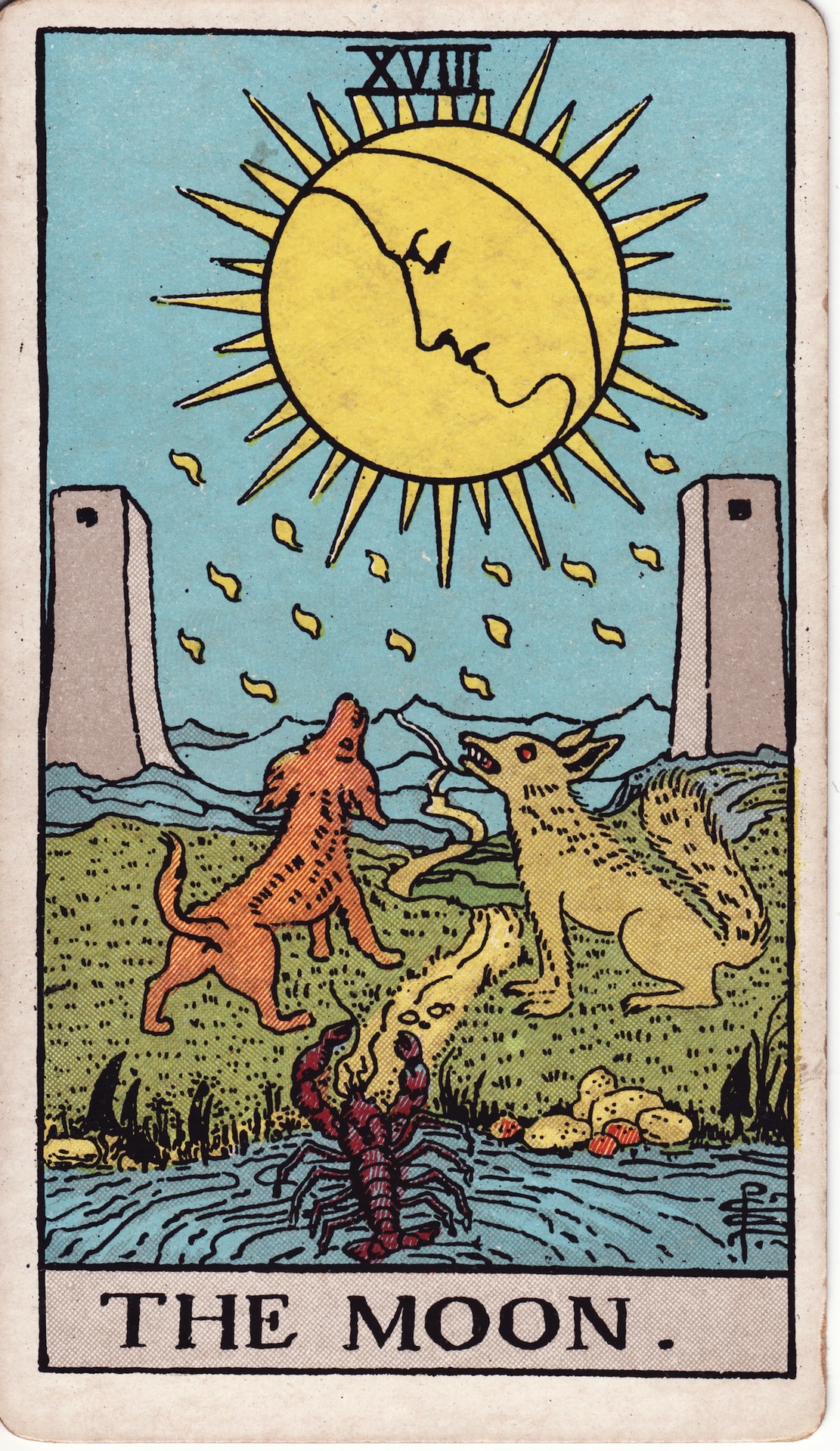
A large moon with a crescent face drawn in profile inside it shines among long yellow rays, letting fall drops of dew. Below it two gray towers stand on either side of a path that winds from the water's edge across green fields and into distant hills. In the middle ground a dog and a wolf howl up at the moon, and in the foreground a crayfish crawls out of a pool toward the land.
Waite wrote that the card represents "life of the imagination apart from life of the spirit." The path is the way into the unknown, and the dog and wolf are the fears of the natural mind when only reflected light is there to guide it. The crayfish stands for something nameless rising from the deep, which as a rule sinks back. Above it all, he said, the face of the mind looks calmly on the unrest below, and the falling dew is the dew of thought.1 Modern readers add that the pool is the subconscious, the crayfish is awareness taking its first clumsy steps out of it, and the dog and wolf are the trained and untrained halves of one mind, lit only in patches.2
Upright
The Moon is the card of uncertainty, illusion and the unconscious. Things are not what they seem, and the light is not good enough to tell the difference. Fears, dreams and half-formed intuitions rise to the surface and can be hard to separate from fact. Waite's divinatory meanings are dark: hidden enemies, danger, calumny, terror, deception and error.1 Most modern readings put the emphasis on confusion, and on trusting your intuition while the facts are unclear.
Much of that fear is borrowed from the past. Something painful that was never fully felt gets pushed under, and later it colors the present and the future: someone once let down by a business partner tenses at every handshake, without quite knowing why. The card says those old feelings are stirring again, and that the way through is to meet them rather than bury them again, whether on your own or with help such as therapy or other healing work.2
In love, it can describe uncertainty about where a relationship stands, mixed signals, or secrets and half-truths; it can also show your own anxieties distorting what is actually happening. Be slow to assume the worst, or the best, until you know more. At work, it warns of misinformation, unclear expectations, or someone not being straightforward; avoid signing anything you do not fully understand. With money, it counsels caution about schemes that sound too good and decisions made on incomplete information. A quick choice made now may turn out later to have rested on only part of the story.2
The inner side of the Moon is richer. It belongs to dreams, imagination and intuition, and asks you to attend to what surfaces from below rather than pushing it down. That means sensing your way through a situation instead of reasoning it out, and quieting the inner critic long enough to hear something else.2 Some readers also take the card as a prompt to work with the actual lunar cycle: starting things and stating intentions at the new moon, and at the full moon taking stock of what has been gained and what should be let go.2 The path between the towers goes on into the dark; walk it slowly, trusting your instincts and checking them against reality as the way grows clearer.
Reversed
Reversed, the Moon often means confusion beginning to clear. A deception comes to light, a fear is named and turns out to be smaller than it seemed, or anxiety eases enough to let you see the situation as it is. Waite's reversed meanings fit this softer version: instability, inconstancy, silence, and lesser degrees of deception and error.1 Seeing how a fear has been steering you is often what loosens its hold, and that can feel like a real release.2
It can also point to fears you have not yet looked at: worry that runs in circles, or an intuition you keep overriding. Sometimes the reversal shows feelings being pushed further down on purpose, with a brave face over the top. That can hold for a while, but what is buried tends to return and will have to be faced eventually.2 In relationships, this can mean a secret finally surfacing, or a period of mixed signals settling into honesty. It can also mean emotional volatility, moods that change faster than the situation does. At work and with money, the reversed Moon suggests that the facts are becoming available; use them, and do not let old fears keep making the decisions.
Another reading concerns intuition that arrives garbled. Hunches and dreams come, but they do not make sense yet, or they clash with what books or other people say they should mean. Here the card favors your own interpretation over borrowed ones. Write the dreams and impressions down, and return to them once things have settled; their meaning is often plainer in hindsight.2
Sometimes the reversal shows the opposite problem: refusing to listen to intuition at all and insisting on the surface story despite every sign that something underneath is wrong. The advice is to bring reason and instinct into play together, and let each check the other until the way ahead is clear.
Notes
- A. E. Waite, The Pictorial Key to the Tarot (1911), The Moon, https://sacred-texts.com/tarot/pkt/index.htm
- Biddy Tarot, "The Moon Tarot Card Meanings", https://www.biddytarot.com/tarot-card-meanings/major-arcana/moon/